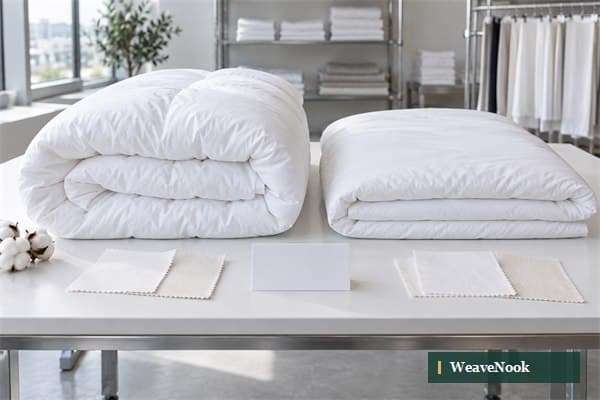
Direct answer: Verify filling mass separately from the completed article’s total mass. Define conditioning, sample selection, shell removal or agreed tare approach and the tolerance decision before the first production lot.
Introduction
A buyer may ask for a 1,000 g down duvet and receive an apparently heavier finished article. That is not necessarily overfilling: the shell, stitching, labels and attachments also have mass. Conversely, a finished duvet that weighs 1,000 g may contain substantially less than 1,000 g of filling. The purchasing question is therefore not “what does the complete duvet weigh?” but “how much specified filling is inside it, and how reliably can that amount be verified?” This distinction becomes especially important when comparing suppliers whose shell fabrics, sizes and constructions differ.
This guide is for hospitality and retail teams building a down comforter fill weight tolerance into a purchase specification. It explains how to define the claimed quantity, sample the lot, choose a measurement route, record uncertainty and decide whether production can be released. It does not report WeaveNook test results or claim a universal fill tolerance. Those details belong to the buyer’s signed specification and an appropriate laboratory or inspection agreement.
Start with the intended duvets and down comforters rather than a generic “queen-size” name. A shell’s finished dimensions, baffle construction and fill distribution affect the physical article being weighed. The separate baffle-box comparison explains how chamber design changes distribution; this article concentrates on the *quantity* of filling. A strong design can still be underfilled, and a correct total fill mass can still be badly distributed.
Define the measurand before asking for a result
Net filling mass is not finished-product mass
Write the target as “net mass of filling in the finished duvet,” with the units, nominal amount and agreed tolerance. State whether any non-filling elements inside the shell are included. For a mixed down-and-feather specification, the net mass applies to the total plumage filling; the blend ratio is a separate question. Labels should not imply that fill power, down percentage, total weight and net fill are interchangeable. All four describe different properties and call for different evidence.
An intuitive but weak shortcut is to weigh a completed duvet and subtract an estimated shell weight from a different sample. Small differences in fabric width, binding, labels and construction can accumulate. If a tare calculation is proposed, ask how representative empty shells were selected, how their mass varied, and whether the calculation is acceptable for the buyer’s decision. For a contested claim, a reserved finished article that is opened and emptied using a defined procedure provides a clearer basis, although it destroys a saleable unit.
The IDFL explanation of down and feather tests distinguishes net fill weight from other down tests and describes weighing a finished product before additional testing. Buyers should request the exact current method and sample preparation used for their order. A method name alone is not a complete report; sample identity, condition, measured result and any calculated mass belong in the evidence package.
Specify the point in the production journey
Net mass can be discussed at the filling machine, immediately after sewing, after conditioning, at shipment inspection or after arrival. Those are not automatically comparable states. Down and feather interact with moisture in their surroundings, and handled goods may experience different temperature and humidity. IDFL’s net-fill discussion specifically cautions that moisture conditions can affect observed net weight. That does not justify an arbitrary correction factor; it means the parties must agree on conditioning and reporting.
If the consumer label or purchase order describes a nominal fill mass, specify when and how it will be verified and which report controls acceptance. Keep the production dosing record as a process check and the finished-product result as a separate check. A machine setting shows what was intended to enter the shell; it cannot by itself prove what remains after trimming, repairs, transfer losses or rework. The time point matters for a fair supplier comparison.
Build an unambiguous mass specification
Use a size-by-size fill matrix
List each size, construction and fill target. A duvet range may use the same shell material across sizes but a different chamber map and mass allocation. Avoid copying a single fill number down a size column. State if two retail names correspond to one physical size, and do not silently substitute an “all-season” construction for a lighter-season model. The matrix should show the article code, revision, fill material code, nominal net mass, tolerance, and the approved method used to verify it.
The tolerance should be chosen against product positioning, measurement capability, cost and the applicable destination-market claim rules. This guide deliberately does not prescribe a percentage. A tolerance that is narrower than process and test variation can produce expensive disputes without improving customer experience; one that is too loose may undermine the advertised product. Ask the technical team to provide trial data from representative samples before locking the acceptance window. The buyer and supplier should sign the same values.
| Record field | Buyer question | Evidence to retain |
|---|---|---|
| Article and size | Which exact SKU is weighed? | Finished size and revision code |
| Fill identity | Which down or feather lot entered it? | Fill lot and composition record |
| Target net mass | What quantity is claimed? | Signed size-by-size matrix |
| Measurement state | How was the sample conditioned? | Time, atmosphere and preparation notes |
| Measurement route | Open-and-empty or justified tare? | Work instruction and calculations |
| Decision rule | What happens near a limit? | Agreed tolerance and release authority |
Separate filling-machine checks from destructive verification
An in-process operation can weigh the charge assigned to a chamber or entire shell, but a charge record is not the same thing as a finished duvet net fill test. Decide how frequently the charge is checked, what scale is used and how drift is detected. If a machine displays a setpoint, log actual checks rather than printing the setpoint as if it were an observation. Keep the lot, date, operator and scale identification traceable.
A finished-product verification should deliberately select pieces from a defined production lot. If destructive opening is required, agree who selects the units, who witnesses the opening, how filling trapped in seams is recovered and whether the shell is weighed separately. Record exceptional findings such as spillage or mixed materials. The opened unit should be clearly identified as a laboratory or inspection specimen, never returned to ordinary stock without an agreed disposition.
Turn the decision into a sample brief
Share the product, target market, planned quantity and duvet net fill weight verification criteria. We can discuss a suitable sample and quotation route.
Get a QuotePlan representative factory testing
Sample the actual range of production
A single conveniently chosen prototype is useful for development but weak evidence for bulk release. Build a plan across sizes, shifts, fill lots and machine settings if those factors vary. The purpose is not to test every duvet destructively; it is to give the buyer a defensible picture of production. Set the number and selection approach before seeing results. Otherwise the team may unconsciously select the heaviest or neatest pieces and miss a drift later in the run.
For example, suppose a hypothetical order has three sizes and two fill lots. A sensible *planning* approach would reserve samples from each relevant combination, or explicitly document why a combination is low risk. Do not quote that example as a required sampling standard. A small pilot run might use more intensive checks than a stable repeat programme. The final plan depends on order volume, loss allowance and the customer’s release agreement.
Control measurement conditions
Record whether the item is sealed, recently unpacked or fully opened and conditioned. Do not compare a compressed carton specimen with an uncompressed retained sample without explaining the handling difference. Use an appropriate calibrated scale with resolution suited to the tolerance. Check zero and container mass, including any collection bag or tray. Protect loose filling from drafts and static-related loss; collect material retained in corners consistently.
Moisture is a plausible contributor to apparent weight change, but guessing at a humidity adjustment after a failed result creates more ambiguity. If moisture is material to the dispute, commission the relevant filling-material assessment and report it separately. The buyer should see raw observations, not only a pass/fail label. Independent laboratories may use procedures that differ from a simple factory balance check; compare the method scopes before averaging or rejecting results.

Do not lose the chamber story
Total mass is necessary but insufficient. A duvet can contain the specified fill overall while one zone is starved. If the construction uses individually filled chambers, document how the intended allocation was calculated and checked. Some inspection plans weigh portions during filling; others inspect loft and distribution in the finished article. Each approach has limitations. Opening one chamber after completion can alter the article and is not a stand-in for all chambers.
Use the fill map to interpret customer complaints. A complaint that the foot area feels thin may involve chamber allocation, migration, construction or use conditions, not just total net mass. Preserve the measured article and compare it with an identified retained reference. Do not respond by adding a little fill everywhere until the cause is understood. Extra mass can change drape, price and packing, and may still fail to correct a local cold area.
Interpret a result near the limit
Distinguish observed mass from the release decision
Suppose the nominal target in a hypothetical brief is 1,000 g. A reported 995 g is not automatically a failure or pass without the signed tolerance and decision rule. Likewise, 1,005 g is not automatically “better”; it could change cost and performance. The test report should show individual results, sample identities and measurement conditions. If a lab reports uncertainty, the buyer and supplier need a pre-agreed rule for how that uncertainty affects acceptance.
Never use the average alone to hide an individual piece that is materially low when the contract limits each unit. Conversely, do not treat a low outlier as evidence that every unit is low without investigating sampling and measurement. Examine whether results cluster by fill lot, operator, size, shift or equipment. That pattern can guide a targeted hold or additional sampling. The written response should state which stock is affected, which remains under control and who is authorised to release it.
Preserve chain of custody for disputes
Give every reserved duvet a unique identifier before opening. Photograph its intact label, carton mark and condition; record who selected it and where it came from. Keep the emptied shell, fill and associated report linked. If a buyer asks a second lab to evaluate the same lot, agree whether a new sealed unit is required. An already opened sample is unsuitable for many finished-product observations and can invite arguments about loss or contamination.
If a shipment inspection detects a low net fill result, first confirm that the right SKU, current specification and valid test procedure were used. Then hold the affected lot while investigating. A supplier may propose rework, replacement or expanded testing; each option needs buyer approval and traceability. A verbal assurance that “the machine was set correctly” is not evidence that finished units conform. The wider sampling and shipment release guide explains how to define lots and decision authority.
Connect net fill to other buyer questions
Down content, fill power, shell downproofness, warmth and care performance should be documented separately. A fill weight result does not verify any of them. A higher percentage of down at the same total mass can change the material proposition; a different shell may change total article weight without changing fill. Conversely, a warm-feeling development sample does not establish the label’s net fill quantity. Avoid collapsing different certificates into one “quality passed” line.
For a retail programme, the net-fill claim needs to agree with packaging, online copy and the actual production specification. For a hotel programme, stock may be identified by internal SKU rather than consumer-facing weight, but the mass can still affect drape and replenishment consistency. Keep the engineering description useful to the purchaser and realistic for operations. If you plan a lighter variant, give it its own code and test plan instead of quietly revising the current product.
The golden-sample retention guide is relevant here: a retained specimen offers a handling and appearance reference, but cannot replace a numerical filling-mass record. Store the signed matrix, process log, sampled finished-unit results and disposition together. A future production team should be able to see which fill target and tolerance were active at the time of each order, even if the name and appearance stayed similar.
Prepare a fill-weight inquiry that can be quoted
Give the supplier the intended use, market, finished sizes, shell construction, fill composition, target net mass per size, tolerance and verification requirement. State whether destructive testing units are budgeted and whether the buyer wants an independent report. Include packaging constraints, since compressed shipment and long storage may affect how samples are conditioned and reviewed. Ask for the proposed fill map and mass-control method at quotation, not after a price has been accepted.
If the supplier suggests a different fill mass to reach a price, ask for a separately identified alternative sample. Compare weight, appearance, warmth evidence and cost on the same basis. Do not allow “equivalent” to mean merely similar total article weight. The goal is an honest, inspectable offer whose contents can be repeated. A useful response identifies uncertainties early, proposes samples and explains which claims require external testing.
Frequently Asked Questions
Can I calculate net fill by subtracting shell weight?
You can use a tare-based calculation if its assumptions and variability are justified for the decision. It is less direct than opening and weighing a finished specimen, particularly when shell mass varies by fabric lot, size or trim. Define the empty-shell sampling and calculation before production. For a disputed label claim, ask a competent laboratory which method is appropriate.
Is a heavier completed duvet always better?
No. Total article mass includes shell, construction and trim, so it does not reveal filling quantity by itself. More filling is not automatically better for a seasonal or hotel product either; it can alter drape, thermal profile and cost. Compare finished products against the signed target and intended use, rather than ranking them only by scale reading.
How many finished duvets should be opened?
There is no universal number in this guide. The buyer’s plan should consider lot size, sizes, fill lots, production variation, the cost of destructive testing and the risk of a wrong label claim. Choose units before seeing their appearance or weight. Keep in-process records alongside finished-product verification, but do not substitute one for the other.
What if a result changes after shipping?
First check sample identity, handling, conditioning, test method and scale. Down and feather can interact with environmental moisture, so conditions matter. Do not invent a blanket correction after the fact. Compare sealed retained units and records, then ask a qualified lab for appropriate material or finished-product testing if the result affects a contractual decision.
Conclusion
Duvet net fill weight is a testable product claim only when the buyer defines the actual filling mass, the sample state, the method and the decision rule. Keep process doses, finished-unit results and shell mass distinct. Reserve traceable specimens, examine patterns across the lot and investigate low results before release. That turns an easy-to-misread number into a practical specification and shipment-control tool.
Primary sources and method boundaries
Sources reviewed October 9, 2026. Illustrative calculations and proposed review checklists are not certified test results. Confirm the applicable method, edition and acceptance limits with your laboratory and customer.
Send your project requirements
Email info@WeaveNook.com with sizes, materials, care route, volumes and destination. Project-specific evidence and capability must be confirmed for your order.
Send Your Requirements