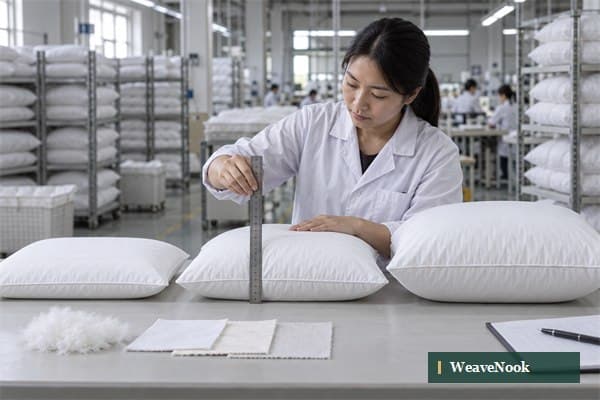
Direct answer: Agree a practical feel range using a controlled sample panel and repeatable compression observations. Record pillow size, fill, shell and conditioning; loft alone does not quantify support.
Introduction
“Medium-firm hotel pillow” is a useful commercial description but a poor sole acceptance criterion. A pillow can look lofty while offering little support, or feel firm on a showroom table and compress differently under a sleeper’s head. Shell fabric, fill type, net mass, chamber construction and conditioning all influence perceived firmness. When several suppliers are asked to quote the same phrase, they may offer very different products. A procurement team needs a reference experience and a reproducible way to compare samples.
This article explains how to turn a hotel pillow firmness specification into an approval process without pretending that one compression number captures every guest’s comfort. It covers sample matrices, simple physical observations, user panels, care trials and replenishment checks. It is a proposed purchasing framework, not a report of measured WeaveNook results. Acceptance limits should come from the hotel’s application, laboratory advice where appropriate and the buyer’s agreed benchmark.
Explore the pillow product range first and decide whether the programme needs a single versatile pillow or multiple guest options. The pillow fill and loft guide covers broad material selection; here the narrower decision is how to compare *support feel* and approve a stable production target. Avoid relying on loft alone. A tall sample may compress easily, while a lower-profile sample can feel resistant.
Define firmness in terms of use
Distinguish first touch, compression and recovery
First touch is the initial surface feel when a hand contacts the pillow. Support is the resistance encountered under a sustained load. Recovery is how the pillow returns after the load is removed. These properties can differ. A down-and-feather blend may have a different compression curve from a fibre-filled or foam-core pillow even if their uncompressed heights match. The procurement brief should say which sensation matters to the guest experience.
Ask the hotel whether pillows are used for sleeping only, reading in bed, decorative layering or all three. A pillow that feels supportive when upright against a headboard may behave differently for side or back sleeping. No single purchase can satisfy every guest, so the buyer may choose a principal pillow with an optional alternative. The goal is a defensible, repeatable range rather than a universal comfort claim.
The sample should be assessed inside the intended protector and pillowcase. Those layers can modify the initial hand feel and apparent loft. A naked pillow on a factory bench is not the guest-facing system. Keep the cover size consistent when comparing alternatives; a tight case can compress one sample more than another, while an oversized case can make both look less controlled.
Create a physical reference, then describe it
An approved sample is valuable, but it should not be the entire specification. Identify its dimensions, fill identity, mass, shell, closure, conditioning and code. If a hotel has a successful incumbent pillow, reserve several representative examples, including a new or lightly used unit, rather than comparing everything to one heavily worn piece. Record what the hotel likes and what it wants changed.
Use controlled language such as “support under normal head load” or “soft initial contact with limited bottoming out,” then develop observation points that make those phrases reviewable. Do not assign “firmness 7/10” without explaining the panel and scale. A customer’s subjective target can guide development, but a contract should include measurable or agreed visual references where feasible.
| Dimension | Sample question | Record |
|---|---|---|
| Unloaded profile | What is the resting height after conditioning? | Location and measurement method |
| Compression response | How far does it compress under an agreed load? | Load, time and measured height |
| Recovery | What profile returns after unloading? | Recovery time and condition |
| Guest-panel feel | How do intended users describe support? | Panel instructions and coded responses |
| Care stability | Does the feel change after the approved route? | Wash/dry history and re-assessment |
Build a comparable sample matrix
Hold variables steady
When comparing filling types, start with the same nominal size, shell and cover system if possible. If each supplier uses a different shell, record that change as part of the product rather than attributing all differences to fill. Make coded samples so a panel is not unduly influenced by brand or price. Include at least one current reference and one alternative that tests a meaningful hypothesis, such as lower mass, different blend or a modified chamber.
Do not let a pillow-maker hand-fluff one prototype immediately before the meeting while the control has sat in a bag. Agree conditioning and handling for all samples. The ISO 139 overview explains standard atmospheres for textile conditioning and testing; laboratory methods may specify their own preparation. A practical hotel panel need not copy a laboratory atmosphere, but should still compare samples after similar unpacking and rest.
Separate panel preference from a formal test
Ask several relevant people to evaluate pillows in a normal bed setup. Use the same pillowcase, room and basic instructions. Collect short individual notes before group discussion to reduce one strong opinion dominating the result. A panel can reveal that one sample feels too springy or collapses under the head, but it is not a clinical study or a universal guest-satisfaction statistic. State its limitations.
For a more repeatable physical comparison, agree a platen or similar compression approach with a qualified laboratory or engineering team. The load, contact area, hold time and recovery interval matter. Record them all. A supplier’s isolated “firmness” number is not comparable with another supplier’s number if the procedures differ. Do not invent a universal newton threshold for pillows with different fills and sizes.
Turn the decision into a sample brief
Share the product, target market, planned quantity and hotel pillow firmness specification criteria. We can discuss a suitable sample and quotation route.
Ask for Product CatalogTest the pillow as it will be packed and cared for
Packaging can change the first-use experience
If pillows are shipped compressed, compare an unpacked control and a unit stored in the proposed package for a defined period. Record how quickly the unpacked profile returns and how the support feels after a consistent recovery time. A product that needs vigorous manual fluffing may add labour for housekeeping or disappoint a retail customer. The compression-recovery guide gives a fuller packaging protocol.
Do not assume a taller recovered pillow is firmer. Compare compression response and feel, not only height. Inspect the cover for wrinkles, seam distortion or filling lumps. If a sample needs a special unpacking procedure, that instruction should be included in the supply plan and validated by the user. “Vacuum packed” is a logistics choice, not a quality grade.
Use the intended laundry route
Hotel laundering can be more demanding or different from domestic care. Ask the operator for actual wash, drying and finishing conditions rather than using a generic care label as a test programme. Compare the conditioned pre-care sample with a post-care sample after an agreed number of cycles. Look at clumping, migration, seam condition, mass change, dimensional change and support feel. These findings are different; do not collapse them into a single “wash passed” statement.
The IDFL synthetic-fill testing service illustrates that bulk filling and finished-product properties can be assessed separately. For foam or mixed constructions, consult appropriate methods for those materials. A lab report on raw fill cannot establish that a sewn pillow retains the approved feel after care. Conversely, a small in-house panel should not be presented as a certified material test.

Keep the programme workable for housekeeping
Fit and changing speed matter
Check how the approved pillow fits the hotel’s existing cases and protectors. Overstuffing can make insertion difficult and stress seams; understuffing can create a sloppy appearance. Have housekeeping staff assemble the intended system and record practical difficulties. The pillow protector versus pillowcase guide helps clarify which layer the buyer expects. A protective layer may alter firmness sensation, so keep it in the comparison.
If the hotel has mixed pillow stock, identify the new SKU clearly without creating uncomfortable or conspicuous labels. Plan storage, replacement and cleaning workflows. A pillow that requires unusually long drying or specialised handling may increase operating cost even if its initial sample is preferred. Ask for a replenishment plan that uses the same controlled construction, not a one-off presentation prototype.
Control feedback after introduction
A small pilot at one property can reveal operational issues before a chain-wide order. Record room type, pillow variant, laundry cycle and user feedback without promising that a few comments represent all guests. Look for recurring themes: a pillow flattening, overheating, clumping or being hard to fit into cases. These are prompts for targeted investigation. Do not retroactively rewrite the acceptance criterion to rationalise a complaint.
If the pilot shows a problem, compare unused retained pillows with used ones. The difference can indicate use or care effects, while a similar fault in both may point to design or production. Document any modification and produce a revised approval sample. A quiet change in fill quantity can shift support and cost even when the exterior appears identical.
Translate observations into a purchasing specification
Write a support profile, not a vague adjective
State the nominal size, shell, filling material, net fill mass or construction detail, preconditioning and approved reference. Add any physical compression method, its result range and its role in release. If a panel is part of approval, document how samples are coded, who participates and how a decision is recorded. A brand may prefer a softer hand with moderate resistance; a hotel may prefer a compact, easy-to-launder pillow. The brief should reveal that difference.
Set reasonable variation limits based on representative production, not a perfect prototype. If the first batch varies, investigate whether the cause is material lot, filling dose, shell dimensions or packing state. Do not ask inspection staff to judge “medium firm” with no reference or procedure. Their visual and tactile checks can be valuable when tied to an approved, identified sample and clear escalation rule.
Inspect the right population
Define lots by production date, filling batch and SKU. Take samples from beginning, middle and end of production if meaningful. Check size, fill mass, appearance and identified compression or feel criteria. Hold a current approved reference under suitable storage conditions. If a shipment shows a cluster of unusually soft pieces, determine whether it affects one fill lot or the whole run before releasing or rejecting inventory. The lot-sampling guide explains why scope and release authority should be decided in advance.
Do not confuse a supplier’s “hotel grade” label with evidence. Ask which properties justify the proposal and which can be inspected. The same applies to terms such as anti-allergy or ergonomic: they may imply claims beyond an ordinary firmness brief. Require appropriate support or avoid the claim. A credible product description is more useful than a long list of unverified adjectives.
Compare quotation economics fairly
The cheapest pillow per unit may require more frequent replacement, but do not invent a service-life number to justify a higher price. Compare material, filling mass, shell construction, care compatibility, carton volume, sample evidence and expected handling. If a premium sample performs better in a pilot, quantify the observed difference honestly and revisit the total cost with the operator. A hotel may value faster housekeeping and fewer stock complaints; another may prioritise a low initial cost.
Ask for pricing by variant if the programme includes soft and firm options. Keep label and packaging codes distinct. A single compressed carton containing mixed variants can cause receiving errors unless the outer marks are clear. Decide whether the new pillow should match existing protectors, cases and storage bins. Those compatibility details often matter more than a small change in an abstract firmness score.
Frequently Asked Questions
Is pillow loft the same as firmness?
No. Loft is height or bulk under stated conditions; firmness concerns resistance to compression and perceived support. A tall pillow can collapse easily, while a lower one can feel firm. Compare both on the assembled bed, with the intended case and protector. If numerical testing matters, specify the load and timing.
Can one physical sample define the bulk order?
It is a helpful reference but not a complete control plan. Record its materials, dimensions, mass, preparation and construction. Add agreed tolerances or a repeatable comparison method. Protect the reference from wear and replacement without revision. A later supplier should be able to understand what was approved beyond one ageing pillow.
How many people should join a feel panel?
There is no universal number in this guide. Include relevant users and capture individual, coded observations under consistent conditions. Use the panel to compare options and detect concerns, not to claim a statistically proven guest preference without a properly designed study. Combine feedback with physical and care evidence.
Should the hotel choose one firmness for every room?
That is an operating decision. One well-defined principal pillow simplifies inventory, while an additional option can serve different preferences. Assess cost, housekeeping and storage implications. If variants are offered, give each its own SKU, label, approved reference and replenishment specification so production does not blur them.
Conclusion
Hotel pillow firmness becomes a manageable purchasing decision when the buyer defines support in use, compares coded samples consistently and records a reference plus measurable controls. Evaluate the complete pillow system after the actual packing and care route. Keep subjective guest feedback distinct from physical tests, and use both honestly. The result is a repeatable product brief rather than a vague “medium-firm” promise.
Primary sources and method boundaries
Sources reviewed October 9, 2026. Illustrative calculations and proposed review checklists are not certified test results. Confirm the applicable method, edition and acceptance limits with your laboratory and customer.
Send your project requirements
Email info@WeaveNook.com with sizes, materials, care route, volumes and destination. Project-specific evidence and capability must be confirmed for your order.
Send Your Requirements