
Direct answer: Custom bedding MOQ is determined by the product’s material, colour, fill, size range, packaging, printing or labels and the production setup required. The most useful way to request MOQ guidance is to send the intended specification and forecast quantity, then ask which elements drive the minimum.
1. Define the buyer decision
MOQ is not one fixed number for every bedding product. It changes when a project introduces a new fabric, colour, fill, construction, label, package or production setup that must be planned and purchased separately.
A small opening order can be commercially sensible, but it should be designed around practical production choices. Reducing custom variables or grouping compatible SKUs may lower complexity more effectively than asking a supplier to quote an undefined low quantity.
2. Build a checkable specification
The following points turn this buying question into details that can be stated in an RFQ and reviewed on a finished sample.
Fabric and colour
Custom dyeing, prints, special widths and low-volume colour runs can affect material purchasing and production planning.
Fill and construction
A standard fill or repeat construction may be easier to plan than a new combination with unique chambers, quilting or components.
Packaging and printed items
Custom boxes, inserts, hangtags, labels and barcodes have their own lead times and minimums, even when the bedding quantity is manageable.
SKU count
The total order can be substantial while each size or colour SKU is too small for an efficient run. Share the full SKU matrix early.
Ready to compare a real specification?
Send your custom bedding MOQ explained requirements for a focused quotation and sample discussion.
Get a Quote3. Set the sample and inspection route
The factory-planning conversation should separate product MOQ from packaging, label or print minimums. During sample development, record every custom component so the buyer can see which items need early ordering before bulk production.
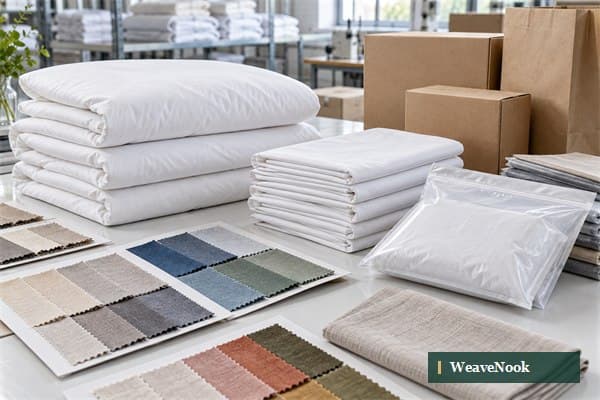
4. Compare the available approaches
| Order approach | Operational effect | Buyer action |
|---|---|---|
| One repeat construction | Simpler material and line planning | Concentrate opening volume on the core SKU |
| Many small variants | More changeovers and component planning | Review which colours or sizes can be grouped |
| Custom packaging launch | Separate packaging minimums may apply | Confirm packaging MOQ and lead time independently |
5. Avoid these sourcing mistakes
- Asking for MOQ without sending a product brief
- Assuming a total order quantity applies equally to every colour and size
- Ignoring packaging minimums
- Changing construction after materials have been planned
Frequently asked questions
Why do custom bedding MOQs vary?
They vary because each project may require different materials, colours, components, machine setup, packaging and SKU distribution.
Can buyers reduce MOQ by choosing standard materials?
Often, a repeat material or construction can simplify planning, but availability and suitability still need to be confirmed for the product and market.
Does each colour have its own MOQ?
It can. Ask for MOQ guidance by SKU, especially when colour, size or packaging differences change the material or production plan.
When should MOQ be discussed?
Discuss it after the first brief is clear and before finalizing a sample or artwork that depends on a particular quantity.
Turn this decision into an approved brief.
Share the product application, quantity and the specification points above. WeaveNook can then discuss samples and a quotation based on the same finished-product requirements.
Send Your Requirements