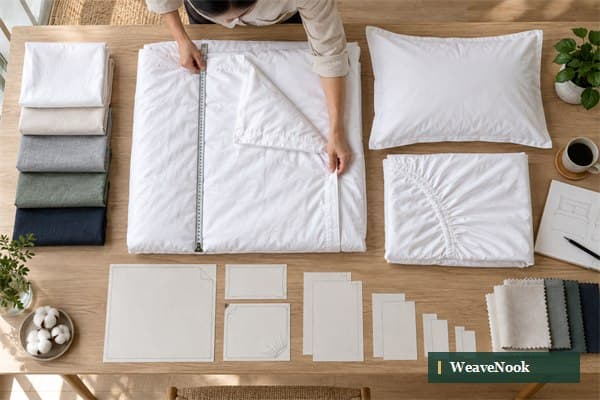
Direct answer: For US, EU and UK bedding programs, specify finished measurements in centimetres or inches alongside the market label. Confirm mattress dimensions, duvet drop, fitted-sheet depth, pillow size and package copy before sampling; never rely only on names such as king or double.
1. Define the buyer decision
Bedding size names do not travel reliably between markets. Queen, king, double and single can refer to different mattress and product dimensions, so an international order needs a measured size chart rather than a name alone.
Regional sizing affects more than the duvet. It changes pillowcase fit, fitted-sheet pocket depth, packaging dimensions, carton count and retail labels. A complete matrix prevents a correct fabric or fill from being made into an incorrect market size.
2. Build a checkable specification
The following points turn this buying question into details that can be stated in an RFQ and reviewed on a finished sample.
Mattress base size
Use the actual target mattress width, length and depth, including any agreed tolerance. This is the starting point for fitted sheets and bed presentation.
Duvet drop and coverage
Set the finished duvet dimensions around the intended bed look, climate and mattress depth rather than copying a label from another market.
Pillow format
Confirm whether the market uses standard, queen, king, continental or other formats and align pillowcases, shams and packing accordingly.
Retail and care labels
Use the local size language only after the measured specification is approved. Labels should match the destination market and actual product dimensions.
Ready to compare a real specification?
Send your bedding size guide US EU UK wholesale requirements for a focused quotation and sample discussion.
Get a Quote3. Set the sample and inspection route
Factory testing for a multi-market bedding program begins with the cut-and-finished measurement table. During sample approval, fit the finished sheet or cover to the agreed size reference and confirm labels, folding and carton marks for each market SKU.

4. Compare the available approaches
| Planning method | Result | Risk |
|---|---|---|
| Market name only | Fast initial discussion | High: terms vary by country and retailer |
| Measured size matrix | Clear sample and quotation basis | Lower: every component is traceable |
| Approved sample on target bed | Visual and functional confirmation | Lowest: fit and presentation can be reviewed |
5. Avoid these sourcing mistakes
- Treating king as a universal measurement
- Using the same pillowcase for every regional pillow format
- Ignoring fitted-sheet depth
- Printing market size labels before the actual dimensions are approved
Frequently asked questions
Can one duvet size be used for every market?
Sometimes a program can standardize selected sizes, but the decision should follow the destination bed matrix and customer expectations rather than convenience alone.
What size information should be sent to a factory?
Send finished measurements, preferred units, mattress reference, intended product application, tolerance where agreed and the destination-market label.
Why does fitted-sheet depth matter?
Pocket depth determines whether the fitted sheet can be placed and retained on the intended mattress, especially where mattress profiles vary.
Should size labels use inches or centimetres?
Use the unit preferred by the target market and retain a measured conversion reference in the technical specification.
Turn this decision into an approved brief.
Share the product application, quantity and the specification points above. WeaveNook can then discuss samples and a quotation based on the same finished-product requirements.
Send Your Requirements