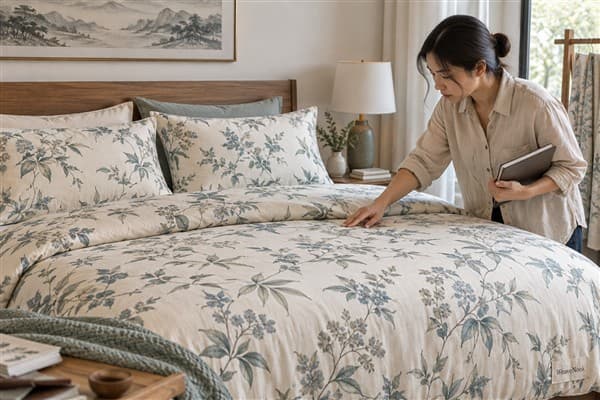
Direct answer: Check colour references, artwork version, print scale and placement, component-to-component consistency, trims, labels and packaging before approving a finished set. Design should be assessed on the made bed and in the final pack, because a repeat or colour that works on a duvet cover may read differently on pillowcases or fitted sheets.
1. Define the buyer decision
A bedding-set design is repeated across several surfaces and folded formats. It needs controls for scale, direction, edge placement, matching components and what the customer will see first at the shelf or online.
Build a design map before production. It should show where each print, solid, trim and label appears on every size and component, and it should identify the physical or digital file that controls the final version.
2. Build a checkable specification
The following points turn this buying question into details that can be stated in an RFQ and reviewed on a finished sample.
Colour and material reference
Approve colour on the actual finished fabric and note how base cloth, sheen, texture and print method affect the result.
Artwork placement
State repeat, scale, direction, engineering or all-over use, seam allowance and placement on each component and size.
Component coordination
Review duvet cover, sheets, pillowcases, shams and any decorative element together to catch mismatched colour, scale or orientation.
Packaging story
Confirm that the insert card, folded product, label and carton show approved design information and do not introduce unsupported product claims.
Ready to compare a real specification?
Send your bedding set color and design sourcing requirements for a focused quotation and sample discussion.
Get a Quote3. Set the sample and inspection route
Factory visual checks should use the signed colour and artwork references, not memory or a low-resolution email attachment. A finished set should be reviewed for print orientation, matching pillowcases, trim continuity and the correct pack artwork before shipment inspection.

4. Compare the available approaches
| Reference | What it controls | Required companion |
|---|---|---|
| Artwork file | Design geometry and version | Placement and seam instruction |
| Strike-off | Print appearance on fabric | Approved component sample |
| Made-bed sample | Whole-set visual balance | Final pack and label review |
5. Avoid these sourcing mistakes
- Approving the duvet-cover print but not the pillowcase orientation
- Using a colour code without a physical fabric approval
- Changing a set component after package artwork is final
- Allowing print scale to vary by size without recording it
Frequently asked questions
Should a bedding-set print be the same scale on every size?
Not always. Decide whether it scales, repeats or is engineered by size, then include that rule in the artwork and sample approval.
How can buyers avoid mismatched pillowcases?
Specify the pair arrangement, print orientation, size, closure and approved reference for each set SKU.
What is the best colour approval method?
Use an agreed physical swatch or lab dip on the actual material with named viewing conditions and a controlled revision.
Do labels affect design approval?
Yes. Labels and insert cards are part of the customer-facing product and should be reviewed with the finished pack.
Turn this decision into an approved brief.
Share the product application, quantity and the specification points above. WeaveNook can then discuss samples and a quotation based on the same finished-product requirements.
Send Your Requirements