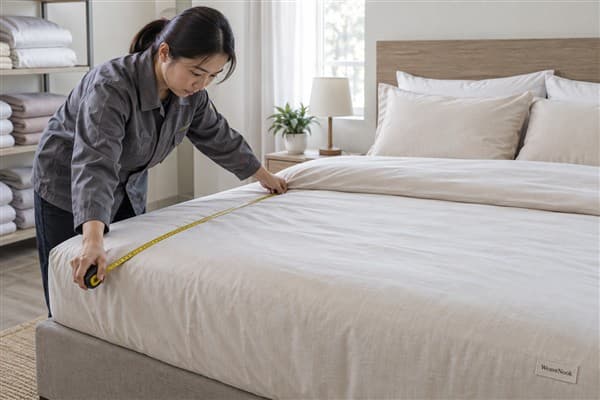
Direct answer: Check the finished measurement of every included item, the matching mattress, duvet and pillow dimensions, closure and pocket requirements, set count, tolerance and market size name. Approve the complete set in its intended fit, because individually measured components can still look or function poorly together.
1. Define the buyer decision
A bedding set can contain items with different fit interfaces. Flat sheets need presentation allowance, fitted sheets need mattress depth, duvet covers need insert compatibility and pillowcases need the correct opening and overlap.
Treat the set as a size system. One market label such as queen should connect to a measured product table, compatible insert and mattress assumptions, and a pack label that lets warehouse and customers identify the exact configuration.
2. Build a checkable specification
The following points turn this buying question into details that can be stated in an RFQ and reviewed on a finished sample.
Component dimensions
List finished measurements, tolerances and measurement method separately for cover, flat sheet, fitted sheet, pillowcase and any optional component.
Fit partner
Identify the intended duvet, pillow and mattress sizes, including depth where fitted sheets are included.
Closure and pocket
Specify closure type, flap or overlap, elastic construction and pocket depth because these control real fit and user experience.
Pack identity
Match the size name, components, barcode and carton mark to the finished size matrix so the right set is received and sold.
Ready to compare a real specification?
Send your bedding set size and fit sourcing requirements for a focused quotation and sample discussion.
Get a Quote3. Set the sample and inspection route
The most useful fit sample is assembled with the intended duvet, pillows and mattress or a buyer-approved equivalent. Factory measurement checks should follow one written method; shipment inspection should verify the relevant finished dimensions and packed size identity against that release.

4. Compare the available approaches
| Fit check | Why it matters | Evidence |
|---|---|---|
| Flat measurement | Controls sewn dimensions | Measured sample record |
| Made-bed review | Shows drape and partner fit | Approved presentation photos and notes |
| Packed SKU review | Prevents size identity errors | Approved label and carton artwork |
5. Avoid these sourcing mistakes
- Assuming a cover size matches an insert without checking allowance
- Omitting fitted-sheet pocket depth
- Approving set labels before dimensions are final
- Mixing US, EU and UK size names in one unqualified product table
Frequently asked questions
Why can a duvet cover look too small when its dimensions are correct?
The insert size, desired ease, closure construction, fabric shrinkage and measurement method all affect practical fit.
What should a fitted-sheet spec include?
Include finished width, length, pocket depth, elastic construction, mattress assumptions, tolerance and the applicable wash or care conditions.
Do pillowcase dimensions need separate approval?
Yes. Opening, overlap, flange, pillow size and visual presentation should be checked on the finished component.
Can a single size chart serve several markets?
Only if it clearly shows the destination-specific product names and exact finished measurements for each market.
Turn this decision into an approved brief.
Share the product application, quantity and the specification points above. WeaveNook can then discuss samples and a quotation based on the same finished-product requirements.
Send Your Requirements