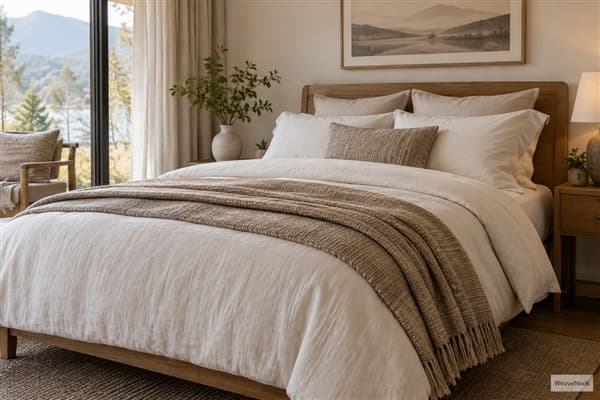
Direct answer: Check how the bedding set is intended to work in the complete sleep environment: fabric construction, included layers, destination climate, hand feel, care routine and customer message. A duvet-cover or sheet set usually manages feel and layering rather than creating warmth on its own, so seasonal claims should describe the actual product role.
1. Define the buyer decision
Seasonality is often expressed through colour and merchandising, but a buyer also needs to decide whether the set is designed for breathability, layering, brushed comfort, decorative use or compatibility with a separate filled product.
Avoid forcing one set to serve every climate. Define whether the programme is a light sheet set, a duvet-cover layer, a brushed seasonal look or a multi-piece bed presentation, then choose fabric and packaging that support that position.
2. Build a checkable specification
The following points turn this buying question into details that can be stated in an RFQ and reviewed on a finished sample.
Layer role
State whether the set sits next to the sleeper, covers a duvet, includes sheets or works with a separate blanket or comforter.
Fabric and hand feel
Specify construction, relevant weight, finish and desired feel through a finished sample rather than broad warmth language.
Climate and customer
Record the destination climate, indoor-use assumptions and whether the buyer needs seasonal colour, material or layer options.
Care and merchandising
Check that packaging and care communication are accurate for the actual fabric and that the product claim does not overstate thermal performance.
Ready to compare a real specification?
Send your bedding set season and warmth sourcing requirements for a focused quotation and sample discussion.
Get a Quote3. Set the sample and inspection route
For seasonal bedding sets, factory testing can verify fabric construction, finished size, colour, sewing and care-related sample response. The buyer should define any comfort or seasonal language before packaging artwork is printed, using only claims supported by the product’s actual configuration.

4. Compare the available approaches
| Set direction | Useful product focus | Message discipline |
|---|---|---|
| Light sheet set | Airy hand feel and fit | Do not imply a separate insulated layer |
| Duvet-cover set | Fabric feel and insert compatibility | Clarify that warmth also depends on the insert |
| Brushed seasonal set | Surface feel and care | Describe construction rather than unsupported thermal outcomes |
5. Avoid these sourcing mistakes
- Calling a duvet-cover set warm without identifying the insert
- Using seasonal colour names as a substitute for product specification
- Selecting a heavier finish without reviewing wash and drying needs
- Copying one climate message across all destination markets
Frequently asked questions
Does a duvet cover determine warmth?
It contributes fabric feel and layering, while the complete warmth outcome also depends on the insert, environment and user preference.
How should buyers plan summer bedding sets?
Define the layer role, desired hand feel, care and destination climate, then approve a finished sample and accurate product language.
Can one bedding set span seasons?
Yes, when it is positioned as a versatile layer and paired with appropriate inserts or blankets; avoid claiming one fixed comfort outcome.
What should be checked before seasonal packaging is printed?
Confirm final fabric, size, care information, product composition, approved claims and the correct SKU-specific artwork.
Turn this decision into an approved brief.
Share the product application, quantity and the specification points above. WeaveNook can then discuss samples and a quotation based on the same finished-product requirements.
Send Your Requirements