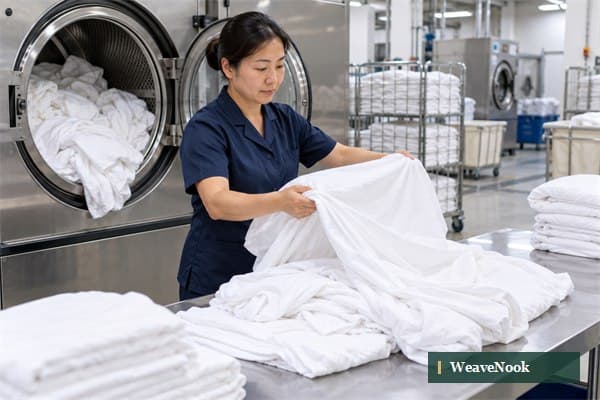
Direct answer: For commercial-laundry bedding, specify the expected care routine first, then select fabric, construction, labels and finishing that are appropriate for that routine. Where testing is required, agree the method, number of cycles, evaluation criteria and finished product configuration before a claim is made.
1. Define the buyer decision
Commercial laundering can expose differences that do not appear in a showroom sample. Bedding should be selected against the property’s own wash, dry, finishing and replacement routine rather than a generic claim that a product is durable.
The care routine influences hand feel, shrinkage, appearance, seam stress and replacement cost. A buyer who describes temperature, chemistry, drying, ironing and handling can obtain a far more useful factory recommendation than one who asks only for hotel quality.
2. Build a checkable specification
The following points turn this buying question into details that can be stated in an RFQ and reviewed on a finished sample.
Wash profile
Describe normal wash temperature, cycle, detergents or bleach policy where relevant, and the operational conditions that matter to the property.
Drying and finishing
State tumble-drying, pressing, ironing or calendering expectations. These processes can influence the preferred fabric and finish.
Construction points
Pay attention to hems, elastic, closures, stitching and quilting, because repeated handling can stress these areas before the main fabric visibly changes.
Evaluation plan
If durability or wash performance must be demonstrated, define the requested test or internal evaluation method, cycles and acceptance criteria in advance.
Ready to compare a real specification?
Send your commercial laundry bedding guide requirements for a focused quotation and sample discussion.
Get a Quote3. Set the sample and inspection route
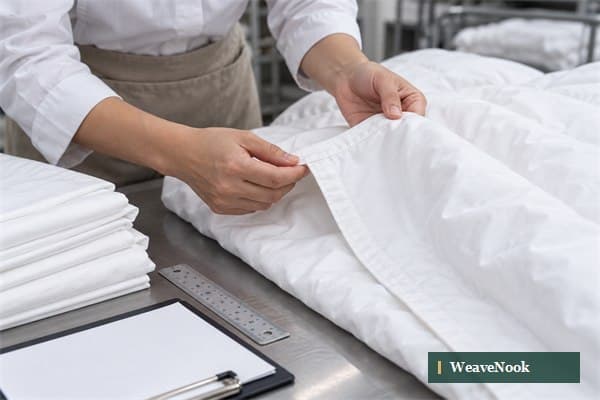
A sample intended for commercial-laundry review should represent the actual proposed fabric, construction, label and finish. Record what changed after the agreed care process, rather than assuming a swatch result will predict a complete product.
4. Compare the available approaches
| Buyer input | Effect on specification | Why it matters |
|---|---|---|
| Laundry process description | Enables relevant material and construction discussion | Reduces generic assumptions |
| Wash-tested sample plan | Creates a shared evaluation point | Shows actual product response |
| Undefined durable request | Leaves scope open to interpretation | Makes comparison difficult |
5. Avoid these sourcing mistakes
- Calling a product commercial grade without defining the laundry routine
- Testing a fabric swatch but not the finished construction
- Ignoring closures, elastic or labels in wash planning
- Failing to agree what counts as an acceptable change after testing
Frequently asked questions
Should bedding be wash tested before bulk production?
When repeated-care performance is important, agree a sample and evaluation plan before bulk production so the buyer can review the relevant finished product.
What needs to be included in a laundry brief?
Include wash, drying and finishing conditions, expected use, product type, target appearance and any criteria the buyer uses to assess performance.
Can hotel sheets and duvet covers have different care needs?
Yes. Their fabrics, construction and use can differ, so each item should be considered within the property’s overall care routine.
Does commercial laundry remove the need for shipment inspection?
No. Laundry suitability and final order inspection are different controls; both may be relevant to the program.
Turn this decision into an approved brief.
Share the product application, quantity and the specification points above. WeaveNook can then discuss samples and a quotation based on the same finished-product requirements.
Send Your Requirements