
Direct answer: When requesting OEKO-TEX® documentation for bedding, identify the exact material or finished product, the intended market and the claim you want to make. Review the current certificate or test evidence for scope, validity and applicable components before using it in product copy or customer communication.
1. Define the buyer decision
Textile documentation is most useful when a buyer knows what it covers. Bedding products may contain shell fabric, filling, trims, labels, elastic, threads and packaging components, so a broad claim must be matched to the actual product and market need.
A certificate name is not a substitute for a product specification. Buyers still need to approve composition, construction, labels, performance requirements and the documentation that specifically applies to the finished program.
2. Build a checkable specification
The following points turn this buying question into details that can be stated in an RFQ and reviewed on a finished sample.
Product components
List shell fabric, filling, thread, elastic, trims, labels and any component relevant to the requested claim or test requirement.
Scope and validity
Review what the document identifies, when it is valid and whether it relates to the material or product being purchased.
Claim wording
Use careful, approved wording that reflects the evidence available. Avoid turning a material document into an unsupported finished-product promise.
Market requirements
Separate voluntary textile documentation from any mandatory product, labelling or safety requirements in the destination market.
Ready to compare a real specification?
Send your OEKO-TEX bedding buyer guide requirements for a focused quotation and sample discussion.
Get a Quote3. Set the sample and inspection route
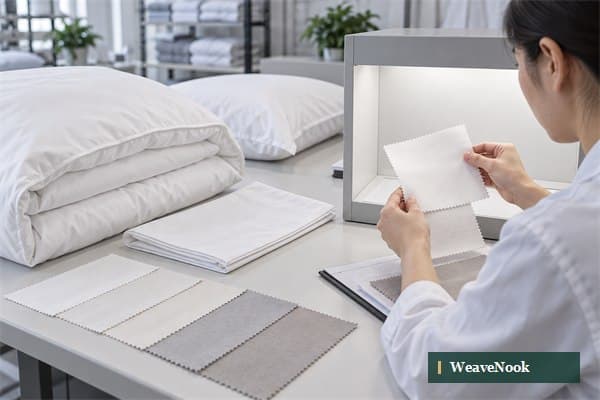
Document review should occur alongside sample review, not after artwork is completed. The product team needs a stable list of components and final descriptions before the buyer’s requested files can be matched to the program.
4. Compare the available approaches
| Evidence type | Useful question | Buyer use |
|---|---|---|
| Material document | Which material and scope does it cover? | Supports material review |
| Finished-product test | Which finished configuration was tested? | Supports product-specific review |
| Market requirement file | What is required for the destination? | Supports launch and import planning |
5. Avoid these sourcing mistakes
- Assuming a fabric document covers every component in a bedding set
- Copying certification language from another brand
- Treating a voluntary textile standard as a full market-compliance plan
- Waiting until shipment inspection to ask what documents are available
Further reading from a primary source
For current STANDARD 100 information and label-use guidance, consult OEKO-TEX® official resources and verify applicability to your finished product.
Frequently asked questions
What is STANDARD 100 by OEKO-TEX®?
OEKO-TEX® describes STANDARD 100 as an independent testing and certification system for textile materials and products; buyers should consult the current official information for their own program.
Can a buyer request documentation for a bedding set?
Yes. Identify the components and final configuration so the supplier can explain what documentation is relevant and what may need additional review.
Is a certificate enough for product quality approval?
No. Quality approval should also cover the agreed specification, sample, construction, labels, packing and any applicable finished-product testing.
How should claims be reviewed?
Review them against the current official rules and the documents that apply to the requested product before they are published.
Turn this decision into an approved brief.
Share the product application, quantity and the specification points above. WeaveNook can then discuss samples and a quotation based on the same finished-product requirements.
Send Your Requirements