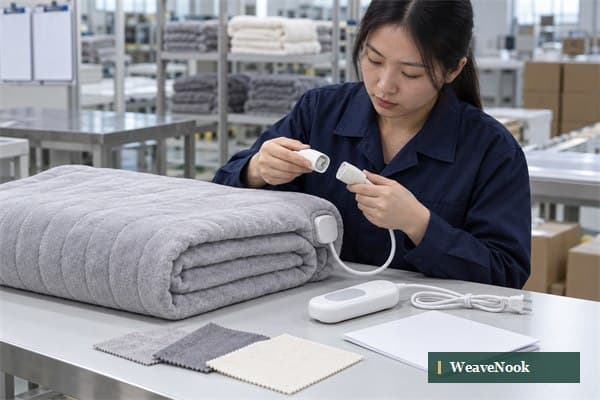
Direct answer: Before developing an electric blanket, provide the destination market, intended voltage and plug, controller requirements, dimensions, textile construction, labels, instructions, packaging and the compliance or testing route required by the buyer. Do not start production on the assumption that one configuration suits every market.
1. Define the buyer decision
Electric blankets should be treated as market-specific electrical products, not as ordinary textile accessories with a heating element added at the end. Destination country, plug, controller, labels, instructions and testing need to be defined before development begins.
The textile layer, electrical components and customer instructions are connected. A change in plug, controller, size, power setting or market label can affect the required product configuration and documentation, so the buyer should stabilize the brief early.
2. Build a checkable specification
The following points turn this buying question into details that can be stated in an RFQ and reviewed on a finished sample.
Destination market
State the country or region before product development. Requirements can differ by destination and should be confirmed by the importer or qualified compliance adviser.
Electrical configuration
Specify voltage, plug, controller, cord arrangement, settings and the intended product application in the technical brief.
Textile construction
Define the blanket size, fabric, layers, edge finish, removable or non-removable elements and care approach alongside the electrical layout.
Labels and instructions
Plan rating labels, warning statements, care instructions, languages, packaging information and customer-use materials as part of the product—not a final-stage add-on.
Ready to compare a real specification?
Send your electric blanket compliance planning requirements for a focused quotation and sample discussion.
Get a Quote3. Set the sample and inspection route
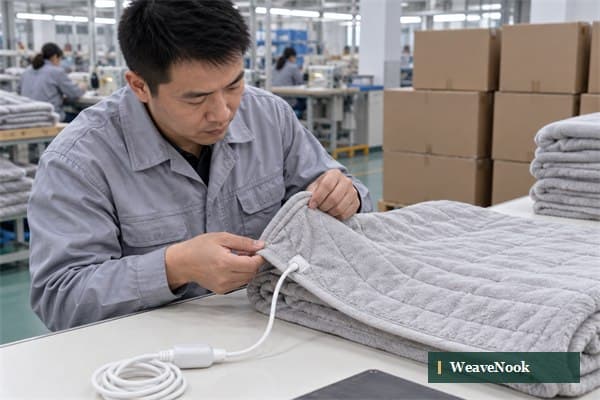
For electric blanket projects, factory testing and production planning should follow the buyer’s approved configuration and required test route. WeaveNook can discuss selected projects, but the importer remains responsible for confirming destination-market obligations with qualified advisers.
4. Compare the available approaches
| Planning stage | Buyer question | Reason |
|---|---|---|
| Market review | What rules and labels apply in the destination? | Sets the development route |
| Sample review | Does the proposed configuration match the technical brief? | Confirms product application |
| Pre-shipment review | Are labels, instructions and packing aligned to the approved configuration? | Reduces dispatch errors |
5. Avoid these sourcing mistakes
- Starting with a generic product without naming the destination market
- Changing plugs or controllers after test planning
- Treating warnings and instructions as packaging decoration
- Assuming a textile care routine applies without considering electrical components
Further reading from a primary source
Electrical product requirements are market-specific. Refer to the applicable authorities and standards for your destination market, and obtain qualified compliance advice before launch.
Frequently asked questions
What information is needed for an electric blanket inquiry?
Share the destination market, product size, voltage, plug, controller, textile preference, expected quantity, required documents and target launch timing.
Can one electric blanket configuration be sold everywhere?
Do not assume so. The buyer should confirm requirements for each target market before selecting a configuration.
Who is responsible for import compliance?
Responsibilities depend on the market and commercial arrangement; buyers should confirm them with qualified local advisers and their import team.
When should testing be planned?
Plan the required testing and documentation before final development and bulk production, because the configuration and labels need to match the reviewed product.
Turn this decision into an approved brief.
Share the product application, quantity and the specification points above. WeaveNook can then discuss samples and a quotation based on the same finished-product requirements.
Send Your Requirements