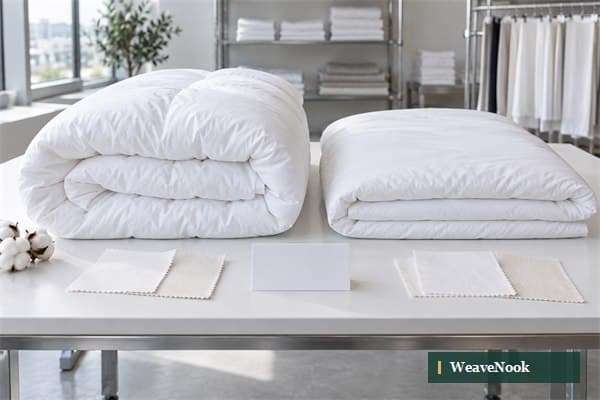
Direct answer: Choose down when the guest experience calls for responsive loft, natural insulation and a premium hand feel, provided the sourcing and care requirements can be managed. Choose microfiber when predictable easy care, a controlled cost position and a broadly familiar synthetic-fill format are more important than the specific feel of down.
1. Define the buyer decision
Down and microfiber can both work in hospitality, but they solve different operational problems. The correct choice depends on climate, desired guest feel, laundering practice, pricing position and the documentation required by the customer.
The most accurate comparison is not “which fill is better?” but “which fill best matches this property’s climate, room rate, housekeeping practice and replacement plan?” A warm all-season duvet that performs well in a cold resort may be unsuitable in a humid, high-turnover city hotel.
2. Build a checkable specification
The following points turn this buying question into details that can be stated in an RFQ and reviewed on a finished sample.
Thermal profile
Compare declared fill weight, duvet size and construction together. A label such as all-season is not a complete performance specification on its own.
Loft and recovery
Down usually has a responsive, irregular loft; microfiber can be engineered for a more uniform initial volume. Ask to handle and recover the approved sample after compression.
Care routine
Confirm the property’s wash, dry and storage conditions. Repeated handling can be more decisive than the first-night feel when selecting a hospitality product.
Traceability and claims
If a buyer requests a responsible-down claim, agree what documentation is required and verify it for the relevant supply chain before using the claim in product communication.
Ready to compare a real specification?
Send your down vs microfiber duvets for hotels requirements for a focused quotation and sample discussion.
Get a Quote3. Set the sample and inspection route
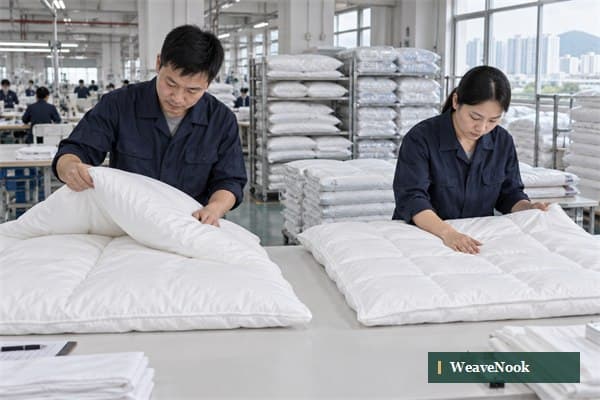
For either fill, factory testing should include actual finished size, declared fill weight, seam security, distribution across the construction and recovery after the packing method. Shipment inspection should compare the packed count and labels with the approved brief.
4. Compare the available approaches
| Factor | Down duvet | Microfiber duvet |
|---|---|---|
| Guest feel | Responsive loft and natural variation | Even, engineered loft |
| Care planning | Needs a care plan suited to the construction | Often selected for straightforward routine care |
| Documentation focus | Traceability may be important for claimed programs | Composition and performance brief are usually central |
5. Avoid these sourcing mistakes
- Comparing fill type without checking fill weight and finished size
- Assuming all microfiber products have the same loft or recovery
- Making responsible-sourcing claims before documents are verified
- Selecting by unit price while ignoring laundry and replacement practice
Further reading from a primary source
For terminology and current program requirements, consult Textile Exchange’s Responsible Down Standard resources and IDFL testing information. Verify relevance to your own material and finished-product scope.
Frequently asked questions
Are down duvets always warmer than microfiber duvets?
Not automatically. Warmth is influenced by fill, fill weight, size, shell and construction, so finished samples should be compared against the intended use.
Can hotels use down bedding in high-turnover properties?
They can, but the care routine, drying capability, replacement plan and sourcing documentation should be considered before the product is specified.
What should buyers ask for when comparing samples?
Ask for the composition, fill weight, finished dimensions, construction, care-label proposal and packing method for each sample.
Where can buyers learn about responsible down standards?
Textile Exchange publishes information about the Responsible Down Standard; buyers should verify applicability and scope with their own approved supplier documentation.
Turn this decision into an approved brief.
Share the product application, quantity and the specification points above. WeaveNook can then discuss samples and a quotation based on the same finished-product requirements.
Send Your Requirements