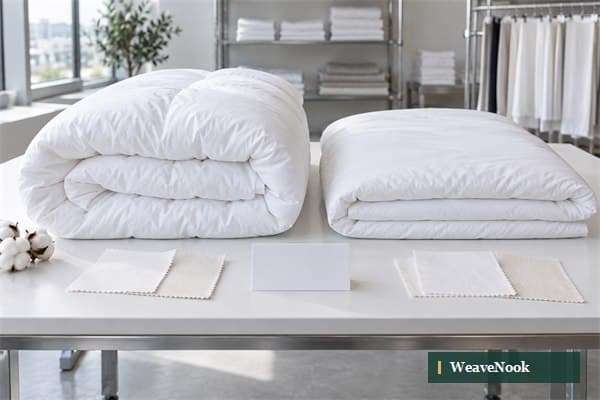
Direct answer: TOG describes measured thermal resistance under defined conditions; fill power describes the loft potential of a down sample. Neither alone establishes the finished duvet’s warmth in use.
Introduction
Buyers frequently place a TOG target beside a fill-power number as though both describe the same thing. They do not. TOG is a measure of thermal resistance under specified test conditions, while fill power describes the expansion or loft of a down sample under a specified conditioning and measurement method. A duvet can use down with a high fill-power result and still miss the intended thermal profile because of its mass, chamber geometry, shell and care state. Likewise, two duvets with similar TOG results may differ considerably in hand feel, drape, weight and price.
This article helps a B2B buyer write a duvet warmth specification without confusing material, finished-product and user-experience evidence. It is not a table of guaranteed bedroom temperatures. A person’s comfort depends on room conditions, sleepwear, mattress, cover, body and preferences. Laboratory results are controlled comparisons, not promises that every guest or consumer will feel identical warmth.
Begin with the intended duvets and down comforters. Then decide whether the question is the quality of the filling, the performance of a finished duvet or the assortment position of a seasonal range. If the purchase decision concerns the construction itself, read the baffle-box and sewn-through comparison alongside this guide. Those engineering details help explain differences that a single numeric field can conceal.
Identify what each metric actually measures
TOG belongs to a defined thermal test
TOG is a unit of thermal resistance. The IDFL explanation of TOG and CLO describes a controlled measurement of heat transfer through a specimen. To use a result commercially, the buyer should know the method, test condition, specimen identity and whether the submitted piece represents the final construction. A TOG number from a fabric swatch is not automatically a TOG number for an assembled duvet. A new, flat specimen in a lab also does not fully reproduce a person sleeping under a cover.
Ask whether the result applies to the entire finished article, a selected area, or a component. Chamber seams and changes in thickness can create regional differences. If the testing partner samples one area, record its location and the reason it was selected. A supplier’s marketing category such as “winter weight” may be useful for sorting a range, but it does not replace a defined test when a buyer has specified thermal resistance.
Fill power belongs to a sample of down
Fill power describes the volume reached by a known down sample under a standard method. It is affected by conditioning and handling, so compare reports only when methods and reporting units match. The IDFL overview of down and feather tests lists fill power separately from content, net fill weight and other assessments. Do not take a fill-power number from a bulk filling report and present it as if it directly measured the warmth of a completed duvet.
Higher fill power can allow a given mass of suitable down to occupy more volume, but that relationship is not a finished-product guarantee. Overpacked chambers may compress the fill; underfilled chambers may create local thin zones. Different shells and quilting patterns can alter thermal behaviour. A purchase order should therefore record both the material specification and, where material to the offer, the finished-duvet thermal target.
GSM and net fill mass answer still other questions
Fabric GSM is mass per area of the shell, not its insulation value. Net fill mass is the quantity of filling, not its expansion, composition or heat resistance. A heavier shell can make the complete duvet feel heavier without adding the same warmth as an appropriate fill change. If the buyer compares an inexpensive synthetic duvet with a down alternative, use comparable finished-product evidence rather than ranking by fill mass alone.
| Buyer question | Useful evidence | What it does not prove |
|---|---|---|
| How lofty is the down input? | Fill-power report under a named method | Finished-duvet thermal resistance |
| How much filling is inside? | Net-fill verification | Distribution or warmth |
| How thermally resistant is the finished design? | Appropriate TOG or thermal test report | Personal sleep comfort for every user |
| How does the sample feel in use? | Controlled assembled-bed trial | Reproducible lab value without testing |
| Will performance persist through care? | Defined care and retest plan | Lifetime warmth guarantee |
Design a seasonal duvet range from the application
Start with the room and user, not a fashionable number
A hotel with climate-controlled rooms may prioritise versatile laundering and guest comfort across a relatively narrow room-temperature range. A retail brand may want clearly separated summer, shoulder-season and winter offers. A student-housing programme may place greater weight on durability and easy care. None of those applications has a single universally correct TOG. Describe the planned environment and customer group so the development team can make a meaningful sample proposal.
Record the intended duvet cover as part of the use system. A thick cover or an additional top sheet changes the experience, even if the insert’s laboratory value stays the same. A sample should be tried with the actual cover, bed and typical room conditions. A controlled user comparison cannot replace a laboratory result, but it can detect heavy drape, local cold zones or excess warmth that the chosen numeric target did not anticipate.
For a multi-season assortment, provide separate SKU codes and approved specifications. An “all-season” product can mean a moderate single duvet or a two-piece system; do not let the name obscure its construction. If a two-piece design is proposed, assess the connection method and combined use case. A single-piece TOG report cannot be added to another result without a method and system-level justification.
Separate target range from performance promise
If thermal resistance is commercially important, agree a finished-product target and acceptance window with a qualified laboratory. Make clear whether the value applies before care, after specified laundering or at both stages. An unusually precise claim can exceed the method’s practical repeatability. Ask about measurement variation and specimen selection before printing a fixed number on packaging.
Do not invent a “warm to minus X degrees” claim from a TOG result. The lab reports insulation under controlled conditions; users have different bedding layers and thermal preferences. Where local consumer regulations or safety requirements affect labels, secure destination-market advice. This guide addresses B2B purchasing evidence, not medical or child-sleep guidance.
Turn the decision into a sample brief
Share the product, target market, planned quantity and duvet tog vs fill power criteria. We can discuss a suitable sample and quotation route.
Get a QuoteDevelop samples that isolate meaningful variables
Compare like with like
If the team wants to know whether a higher fill power materially improves a duvet, keep size, shell, baffle design and fill mass consistent between prototypes as far as possible. If mass changes at the same time, the comparison cannot attribute the difference to fill power. Conversely, if the commercial goal is equal warmth at lower weight, deliberately vary the fill and mass, then assess both finished TOG and user feel. State which question the trial is designed to answer.
A useful development matrix lists sample code, down content, fill power method and result, net fill by size, chamber drawing, shell specification, finished dimensions, test state and observed feel. Label physical samples so a meeting does not turn into a memory exercise. Do not treat one attractive prototype as proof of repeatability. Ask for another sample from a separate production run when a claim or large order hinges on the result.
Examine construction after the test
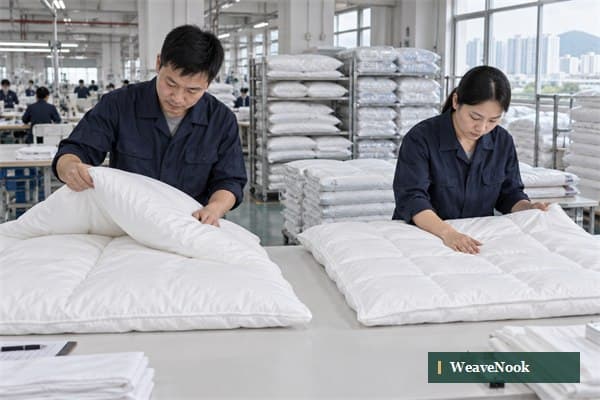
If two otherwise similar samples show different warmth, look at chamber allocation, seam lines and how evenly the filling expands. A direct-stitched line can create a different local profile from a baffled chamber. The same overall net mass distributed differently may produce a different thermal feel. The duvet net-fill guide addresses mass verification; here the challenge is connecting mass and geometry to actual insulation.
Inspect the shell for air leakage and care compatibility, but avoid the simplistic claim that “less air permeability always means warmer.” Fabric properties interact with comfort, moisture and fill containment. A downproof shell needs to retain filling without creating unexamined breathability or drying problems. Use component tests to diagnose, then rely on the finished article for the decision about the finished product.
Ask the laboratory the right question
Specify the sample state
Tell the testing partner whether the duvet is new, unpacked after compression, washed, dried or conditioned. State the cover situation and which areas are relevant. Record sample size and handling history. Two reports are not comparable if one used a newly expanded duvet and the other used a compressed piece straight from a bag. The method may specify conditioning, and the buyer should follow it rather than inventing a convenient in-house version.
If the product claim refers to a maintained thermal rating, agree an appropriate care and retest protocol. This is especially relevant for hotel use with repeated laundering. Do not describe one accelerated cycle as “five years of use” unless there is a defensible equivalence study. A changed TOG result after care should be interpreted alongside dimensions, fill distribution and physical condition; the number alone does not reveal the cause.
Confirm the method’s scope
The publicly available ISO 5085-1 description is for low-thermal-resistance textile materials and notes a thickness limitation. It must not be casually described as a universal thick-duvet test. Ask the lab to select a method appropriate to the thickness and construction of the submitted article. The test report should identify the actual method used, not merely cite an unrelated thermal standard for credibility.
In an RFQ, say what decision the result will drive: range naming, labelling, comparative evaluation or bulk acceptance. Those uses may require different evidence and uncertainty treatment. Confirm whether the laboratory’s report can support the specific claim before artwork is final. A test that was useful for internal comparison may not be suitable as a consumer-facing certification claim.
Interpret results alongside price and use
Imagine two hypothetical duvets with similar finished thermal-resistance results. One uses a lighter, higher-loft down fill and has a higher cost; the other uses more filling or a different construction and is heavier. The better choice depends on the buyer’s desired hand feel, room programme, price tier and care route. A rank order based only on TOG would miss those trade-offs. Record the basis of the comparison so a future sourcing team can reproduce it.
If one prototype misses its target, make a controlled change. Adjusting fill mass, baffle height, chamber distribution or shell at the same time makes the next result difficult to interpret. Change one meaningful factor or document a deliberate design package, then retest the finished product. Do not silently upgrade a raw material certificate to imply the new duvet is warmer. If a substitution occurs during bulk production, determine whether the approved TOG evidence still applies.
For shipment inspection, verify that the correct material lots, chamber drawing and net fill were used, and reserve finished samples if thermal retesting is part of the contract. Inspectors cannot infer a TOG value from hand squeezing or total product mass. A sample that looks flatter may warrant investigation, but not a fabricated numeric judgment. Keep release decisions tied to the agreed evidence and shipment inspection plan.
Write a warmth-focused purchasing brief
Provide intended use, market, finished size matrix, cover assumptions, shell, down content, fill power method, net fill mass, chamber design, care route and desired thermal evidence. If you want a “summer” and “winter” range, state how customers should experience their difference without demanding a made-up universal temperature threshold. Ask the supplier to quote testing as a separate line if needed. Samples should carry unique IDs that align with reports and cost sheets.
Ask for alternatives honestly: a lower-weight premium version, a cost-led standard version or a synthetic alternative may all be legitimate. The comparison should show what changed. Buyers also need to consider packaging; extended compression can affect short-term loft observations even when the material specification is unchanged. Plan recovery and assessment conditions before comparing cartons. The goal is to approve a finished product, not to collect the largest possible metric on a slide.
Frequently Asked Questions
Does higher fill power always mean a warmer duvet?
No. Fill power describes a down sample under a specified method. Finished warmth also depends on the amount of filling, chamber geometry, shell, distribution and care state. Two products using the same fill can perform differently. If warmth is a purchase requirement, specify a suitable finished-product test and compare representative samples.
Can I calculate TOG from fill mass or shell GSM?
Not reliably. Mass and fabric weight are separate measurements. They can help describe a construction but do not provide a validated thermal-resistance result. Ask a qualified laboratory for an appropriate method if the number matters to a product claim. Retain the construction and sample details alongside the report.
Is a TOG result the same as a bedroom temperature rating?
No. TOG characterises resistance to heat transfer in a controlled test. It does not account for every sleeper, mattress, cover, room airflow or sleepwear combination. Use the result to compare and describe products within its scope, and avoid promises about universal comfort at a particular ambient temperature.
Should a hotel retest warmth after laundering?
If retained performance matters to the contract, agree the care route and retest plan before ordering. Compare the washed article with the approved new sample using the same appropriate method. Observe fill distribution, dimensions and shell condition as well. Do not claim a fixed service life from one laundering result.
Conclusion
TOG and fill power are complementary, not competing labels for the same performance. Specify the down input with a defined fill-power method; specify the finished duvet with construction, net mass, care state and thermal evidence suited to the claim. Compare physical samples in the intended bed system and keep laboratory limits visible. A clear brief lets buyers choose warmth, weight, cost and feel deliberately instead of chasing the largest printed number.
Primary sources and method boundaries
Sources reviewed October 9, 2026. Illustrative calculations and proposed review checklists are not certified test results. Confirm the applicable method, edition and acceptance limits with your laboratory and customer.
Send your project requirements
Email info@WeaveNook.com with sizes, materials, care route, volumes and destination. Project-specific evidence and capability must be confirmed for your order.
Send Your Requirements