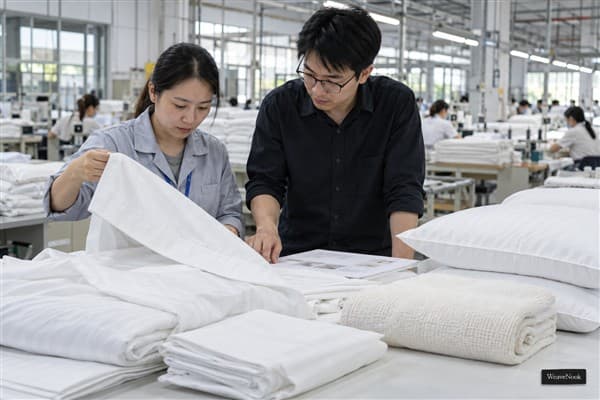
Direct answer: Buyers should choose home textiles by first defining the end use, target customer, price position and care environment, then approving measurable fabric, size, construction, colour, packing and inspection requirements. Compare finished samples and supplier quotations against the same written brief rather than judging products from a photograph or thread-count claim alone.
1. Define the buyer decision
Home textiles can include sheets, duvet covers, pillowcases, blankets, cushions and filled bedding, so a range needs a decision structure before individual SKUs are priced. The useful starting point is the customer experience and operating routine, not a generic request for premium quality.
A boutique hotel, a value retailer and an online brand can all sell white bedding, but they need different balances of hand feel, laundry resilience, presentation, replenishment and packaging. Identify those trade-offs at range level before asking a factory to optimise one isolated item.
2. Build a checkable specification
The following points turn this buying question into details that can be stated in an RFQ and reviewed on a finished sample.
Use and customer profile
Record whether the products are for guestrooms, retail shelves, e-commerce fulfilment or gifting, plus the expected user, climate and replacement pattern.
Material and construction
Specify fibre composition, weave or knit, fabric weight where relevant, filling and finished construction; do not rely on descriptive words such as luxury alone.
Range and size architecture
List every SKU, bed size, colourway, set composition and compatible accessory so patterns, labels and packing are coordinated.
Acceptance route
Agree the sample, colour approval, care-label proposal, factory testing and shipment inspection points before bulk release.
Ready to compare a real specification?
Send your how to choose home textiles for buyers requirements for a focused quotation and sample discussion.
Get a Quote3. Set the sample and inspection route
In factory testing, a complete home-textile range is reviewed as a system: finished dimensions, trim consistency, label placement, packing counts and how each item performs after the handling expected in its application. During shipment inspection, carton marks and SKU identity should match the approved range matrix.

4. Compare the available approaches
| Buying approach | What it controls | Risk if omitted |
|---|---|---|
| Range brief first | Customer, channel and product roles | Individual SKUs may not work together |
| Sample-led selection | Hand feel, construction and presentation | Bulk product may differ from an unmeasured concept |
| Documented release | Production, packing and inspection reference | Unclear changes can reach the shipment |
5. Avoid these sourcing mistakes
- Treating all home textiles as one fabric-and-price decision
- Approving a colour without a defined reference and viewing condition
- Adding packaging requirements after the product quotation is accepted
- Comparing suppliers that have priced different set components
Frequently asked questions
What is included in a home-textile sourcing brief?
Include the product matrix, intended use, material direction, finished measurements, colours, labels, packing, target market, quantity and approval process.
Should buyers start with a full range or a hero product?
Start with the commercial range logic, then develop a representative hero SKU first when it can validate the fabric, colour and factory communication route.
How can a buyer compare home-textile quotations fairly?
Give every supplier the same measurable brief and ask them to state all assumptions, deviations, MOQ, packing and lead-time conditions in writing.
Which quality checks matter before dispatch?
The scope should match the product, but typically confirms quantity, visible workmanship, dimensions, labels, packing and carton identification against the approved reference.
Turn this decision into an approved brief.
Share the product application, quantity and the specification points above. WeaveNook can then discuss samples and a quotation based on the same finished-product requirements.
Send Your Requirements