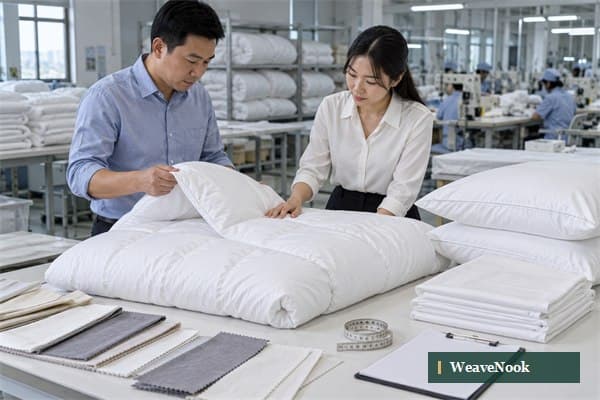
Direct answer: Compare the same artwork at the final cushion size using physical samples. Jacquard develops a pattern through woven structure; printing places colour onto an existing fabric. These routes differ in texture, repeat limitations, reverse appearance and change control. Neither is inherently the premium choice for every buyer, and both need care and fit validation.
Introduction
A geometric cushion artwork can become a woven design or a print, but those production routes will not create identical products. The surface structure, reverse appearance, repeat scale and colour development can differ. A purchasing decision based only on a digital mock-up may discover the differences late, when the design has already been advertised or packaging has been ordered.
This jacquard vs printed cushion covers guide compares production decisions for retail and hospitality buyers. It is not a claim that one route is universally premium or that WeaveNook has produced the example collection. Confirm project capability, material availability and test evidence before ordering. The proposed sample exercises are development recommendations rather than published customer cases or certified results.
Start with the intended cushion range, artwork and commercial use. The retail cushion fill guide helps define the insert and overall presentation. Here the narrower decision is how the cover’s design will be manufactured and controlled, with enough physical evidence to avoid treating a screen image as a finished textile specification.
Understand what the two routes create
Jacquard develops pattern through woven structure
The Cotton Incorporated weaving booklet provides primary technical context for woven pattern development. For procurement, ask the supplier to show the actual proposed construction and yarn arrangement. The word jacquard does not specify fibre, fabric weight, density or durability. It names a route that still needs a complete material brief and physical approval.
Review surface relief, texture and reverse appearance. A pattern may involve longer floats or a different structure in some areas, so the cover should be assessed as the actual design rather than a generic jacquard swatch. Ask the technical team which features need particular care or handling review. Do not assume that a woven motif cannot distort, snag or change during use.
Printing places colour on an existing fabric
Printing starts with a chosen base material and a defined production process. The same artwork can look different on different surfaces and finishes. Ask for the actual proposed base and print route rather than a sample produced by a convenient development technique that will not be used in bulk. Keep colour and pattern approval tied to that configuration.
A printed cushion is not automatically flat-looking or low quality. Its value depends on the design objective and execution. It may suit fine artwork or a particular colour arrangement that is less practical to translate into a woven structure, but this must be confirmed with the supplier. Do not promise unlimited detail or colour accuracy without reviewing physical production-representative samples.
| Decision field | Jacquard route | Printed route |
|---|---|---|
| Design translation | Pattern linked to woven construction and yarn choices | Artwork linked to base fabric and print process |
| Surface review | Texture, structure and pattern areas | Colour placement, clarity and fabric feel |
| Reverse review | Construction and exposed pattern features | Reverse appearance and process-specific effects |
| Approval evidence | Actual woven sample and finished cover | Actual printed sample and finished cover |
Define the artwork before asking for a quotation
State final cushion dimensions, motif scale, repeat, border, orientation and intended placement. A supplier cannot price a meaningful design from a cropped image alone if it does not show how the pattern sits on the cover. Identify whether the buyer wants a centred motif, an all-over repeat or a controlled panel. Each can affect cutting, material use and consistency.
Decorative cushion colour separation should be reviewed with the technical team. For a woven proposal, ask how the artwork maps to the intended yarn arrangement. For a print, clarify the artwork files and colour references needed by the chosen route. Do not prescribe a technical file format without confirming the production workflow, and do not assume that a screenshot contains usable colour information.
Control printed cushion artwork scale
Include dimensions on the artwork and provide a physical or clearly defined visual reference. Review a sample at final size, not only a reduced mock-up. Small motifs can disappear or merge differently on textured fabric, while large motifs may be cut by seams. Ask the supplier to show the seam and opening positions relative to the design before approving a finished cover.
If front and reverse differ, describe both. A plain back, matching pattern or separate design affects materials and appearance. Confirm whether the pattern is intended to match at the perimeter or whether variation is acceptable. A demanding matching requirement should appear in costing and inspection criteria rather than emerge as a surprise during final review.
Review woven cushion pattern repeat and placement
A repeat must be related to the finished panel and cutting layout. Ask how the cover is cut and how much placement variation the proposed design permits. A small all-over repeat may be forgiving, while a single large feature may need tighter control. This guide does not prescribe a universal placement tolerance; set it from the intended appearance and practical production evidence.
Check whether different cover sizes preserve the intended motif scale. Enlarging the panel does not automatically enlarge a woven repeat, while resizing printed artwork may change how the design reads. Review each relevant size layout. Do not approve a small sample and assume the larger retail SKU will display the same centred feature or border proportion.
Inspect jacquard reverse side review points
Look at the inside of the actual sample. Observe exposed threads, seam allowances, lining where proposed and any features that could catch during insert assembly. Ask the technical team to explain whether those features are expected construction or defects. Do not reject a reverse merely because it differs from the face, but do require the approved condition to be clear.
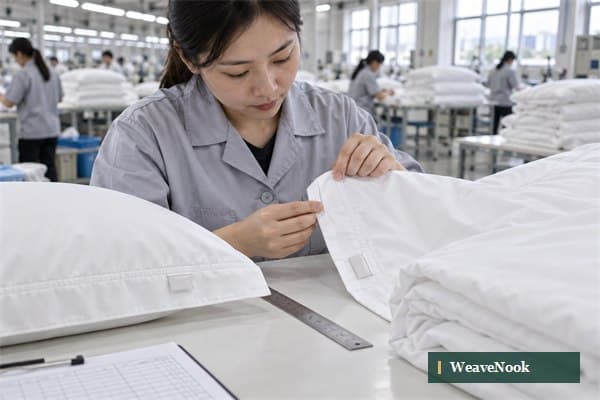
For printing, review the reverse and cut edges as well, without assuming every process behaves identically. A finished cover may reveal seam or backing effects not visible in a flat strike-off. The buyer should see both sides before deciding, especially if the item has an opening that exposes part of the interior during normal handling or merchandising.
Turn this decision into a sample brief
Send the product type, target market, planned quantity and your jacquard vs printed cushion covers requirements. We can discuss the information needed for a relevant sample and quotation.
Ask for Product CatalogCompare physical samples under a matched brief
Use the same finished dimensions, intended insert and relevant application when comparing routes. Document where material differences are unavoidable and keep them visible. A heavier textured woven sample and a light smooth printed sample may each be attractive, but their difference cannot be attributed solely to pattern production. The comparison should identify the full configuration.
Place both on the intended insert and photograph them in the same setting. Review corner shape, motif placement, surface texture and overall presentation. Ask relevant buyers or designers to describe specific differences without price labels where practical. Preference feedback helps selection, but it is not a laboratory finding or proof that one route will sell better.
Include colourfastness and care
The ISO rubbing assessment overview provides context for a relevant colour-transfer question. Ask the laboratory to select methods and editions for the actual materials. Printing and weaving do not remove the need for performance evidence. A woven colour can require review just as a printed colour can, depending on the configuration and customer requirement.
Use the intended care route and inspect the complete cover after processing. Record dimensions, shape, seam appearance, colour and design clarity. An informal care trial should be labelled separately from formal evidence. If the item is intended for a hotel, confirm the relevant operating route rather than assuming that a retail home-care sample answers the same question.
Evaluate the cushion design production route commercially
Ask suppliers to identify development work, material minimums, repeat constraints and factors affecting lead time. These vary by project, so this guide does not assign universal MOQs or production days. A detailed artwork brief gives the supplier a basis for a meaningful answer. A vague request for any similar jacquard may produce a stock material rather than the intended custom design.
Compare the complete delivered SKU, including cover, closure, insert if supplied, labels and packing. Do not compare a fabric-only woven price with a finished printed cushion quote. If an alternative uses stock fabric, state that clearly. The price may be attractive, but availability and repeat-order consistency still need review before the collection depends on it.
Consider design changes after launch
Changing a motif, colour or scale can have different development implications in each route. Ask what can be changed within the approved material and what requires a new sample or manufacturing setup. Keep artwork revision control explicit. A minor-looking screen edit can be a meaningful production change and should not bypass technical or physical approval.
For a range with seasonal variants, plan the design architecture with the supplier. Some buyers may keep a common base and vary prints; others may value a consistent woven texture. Neither strategy is automatically better for SEO, retail or hotel use. The choice should follow product positioning, stock planning and actual manufacturing capability rather than a broad claim that one route is always more flexible.
Turn the chosen route into an inspection standard
Retain the approved finished cover, material sample, artwork and placement drawing. State which visual differences are permitted and which are defects. A woven or printed pattern can vary around seams; the specification should distinguish intended variation from a wrong orientation or missing feature. Keep the criteria usable under the agreed viewing conditions.
Factory testing should connect the actual material and design revision to the relevant evidence. Shipment inspection can verify identity, artwork placement, dimensions, workmanship, colour references and documentation within its scope. If independent performance testing is required, reserve samples and time before release. The bedding sample checklist helps organise that approval trail.
Preserve the standard for replenishment
Record material source, design revision and approved colour references. Similar-looking replacement fabric can have different texture, care behaviour or repeat geometry. Review changes rather than treating them as equivalent because the motif remains geometric. A replacement printed base can also change colour appearance and hand feel even when the artwork file is unchanged.
For a complaint, collect the product code, lot and photographs of the full cover, pattern detail and reverse. Identify whether the concern is placement, colour, construction or post-care appearance. A image of a small motif alone may not show the finished-size relationship. Compare the evidence with the actual approved sample before assigning a production-route cause.
Build a clear buyer decision worksheet
Use separate rows for design fidelity, texture, reverse appearance, care evidence, production consistency, cost and lead-time assumptions. Mark unverified points rather than filling them with optimistic scores. Essential conditions should not be averaged away by a lower price. If neither sample meets the brief, revise the design or material and repeat the relevant checks instead of selecting the least unsuitable option.
Keep a short written reason for the final choice. For example, a hypothetical retail buyer might prefer a textured woven route because the approved motif reads well at final size, while another chooses a print for a different visual objective. Those are labelled decision scenarios, not claims about real WeaveNook clients. A documented rationale helps later teams understand why the configuration should not be changed casually.
Frequently Asked Questions
Is jacquard always more premium than print?
No. It creates a different material and design route, not a universal quality ranking. Evaluate the actual finished cover against the brief, including texture, artwork, care and workmanship. A well-executed print may suit one collection better, while a woven structure may support another. The customer’s objective should determine value.
Can the same artwork look identical in both routes?
Do not assume so. Woven structure, yarn choices, base fabric and printing can change the result. Review physical samples at final size and document the translation. A digital mock-up is useful for direction but should not be the only approval evidence for colour, texture, motif clarity or seam placement.
Should buyers inspect the reverse of a cushion cover?
Yes. It can reveal construction, exposed threads, seam allowances and opening details relevant to handling. Ask the technical team which features are intended and which are defects. Keep a reverse reference with the approved sample rather than judging it later against an unstated expectation based only on the face photograph.
What needs review when the base fabric changes?
Review appearance, hand feel, dimensions, care and relevant performance evidence, as well as artwork translation or repeat placement. An unchanged file does not guarantee an unchanged finished product. Identify the new configuration, make representative samples and decide which prior evidence remains applicable before accepting the substitution for bulk supply.
Conclusion
Choose the production route through the final cover, not a premium label or screen mock-up. Define artwork scale and placement, inspect both sides, validate care and performance, and compare complete commercial scenarios. Preserve the approved design and material together. That gives buyers a repeatable collection whose manufacturing route supports the intended appearance rather than surprising it late in development.
Primary sources and method boundaries
Sources reviewed September 28, 2026. Illustrative calculations and proposed review checklists are not certified test results. Confirm the applicable method, edition and acceptance limits with your laboratory and customer.
Send your project requirements
Contact info@WeaveNook.com with the specification, care route, quantities and delivery destination. WeaveNook is based in Shenzhen with an 8,000 m² factory; project-specific capabilities and test evidence must be confirmed for your order.
Send Your Requirements