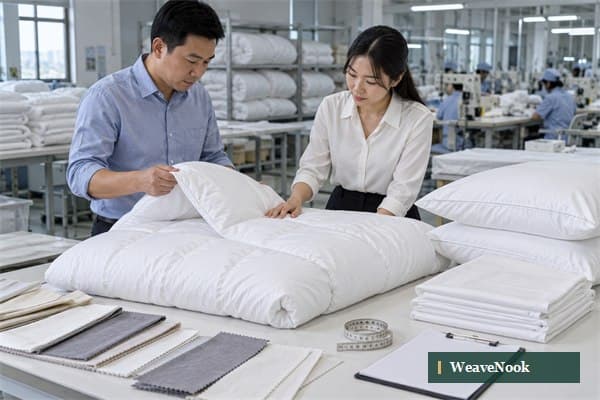
Direct answer: Treat seam integrity, fill leakage and internal migration as different failure modes. Define seam construction and opening limits, evaluate representative finished pillows, and record the exact location of any defect after handling and care trials. Use laboratory methods suited to the product; a generic fabric-strength report does not prove a finished pillow will perform.
Introduction
A pillow with a thin corner, loose filling on its surface and a partly opened edge may have three different problems. Internal redistribution concerns how filling moves inside the shell. Leakage concerns material escaping. Seam integrity concerns whether the construction remains closed and stable. Combining them into one quality score makes corrective action harder and can leave an apparently improved sample with the original failure still unresolved.
This guide builds a pillow seam integrity testing and migration review for wholesale buyers. It is a proposed procurement workflow, not a universal laboratory procedure or a statement that WeaveNook completed particular tests. Choose methods appropriate to the finished pillow and define acceptance criteria with the customer. A woven-fabric strength result may be relevant background but is not automatic proof of the complete article’s durability.
Use the hotel pillow selection guide for fill and application decisions. This article starts after the main pillow specification is known and examines how the selected shell, seams and filling behave together during handling, care and packing. The distinction matters when comparing visually similar samples with different internal construction.
Describe the three failure modes separately
Internal fill migration
Pillow fill migration inspection looks for unwanted redistribution inside the article. Observe persistent empty corners, dense central areas, lumpy zones and an uneven profile. Record how the sample was handled and whether the distribution returns after the approved recovery routine. Some settling may be expected for a given design, but the acceptable condition should be established from the application and reference sample rather than a vague promise of permanent shape.
Do not diagnose migration from one squeezed corner. Compare the entire article laid flat and in its intended pillowcase, using consistent observation conditions. If the fill is intentionally loose and adjustable, explain that feature in the brief and consumer instructions. An adaptable pillow and a fixed-profile pillow should not be judged against the same unspoken expectation.
Escaping filling
Leakage is a separate question. Identify whether material appears through the shell, at sewing penetrations, through an open closure or from external contamination. The IDFL finished-product discussion supports reviewing the complete stitched article where down filling is involved. Do not extend that source into a universal performance claim for every synthetic or specialist pillow filling.
Record the material type and location of release. A feather, loose thread and fragment of packaging are not interchangeable findings. Where the origin is unclear, photograph and retain the evidence for review rather than assigning a cause immediately. If a lab assessment is needed, provide the identified shell, fill and finished configuration instead of only an anonymous surface photograph.
Construction opening or damage
Pillow seam opening defects include separated stitches, broken thread, an incompletely closed fill opening or shell damage beside a seam. Describe the visible condition and whether it existed before handling. A small loose thread is not necessarily an open seam, while an intact-looking stitch line may conceal inadequate fabric capture. Agree the inspection description and allowable condition before shipment.
Check whether an opening has a direct path to the filling. The severity depends on the product and customer criteria, not just the opening’s appearance in a photograph. Do not repair a development sample silently and then use it as the untouched approval reference. Record repairs and decide whether a fresh sample is necessary to demonstrate repeatable production.
| Finding | First question | Evidence to retain |
|---|---|---|
| Empty corner | Does it persist after approved recovery? | Before and after shape views |
| Filling on shell | Where did it emerge or originate? | Location photo and material identification |
| Open edge | Is stitching incomplete, broken or distorted? | Seam detail and sample history |
| Uneven packed sample | Was it already uneven before packing? | Unpacked control and packing record |
Specify pillow edge stitching clearly
The pillow edge stitching specification should identify seam location, approved construction, seam allowance reference and any binding, piping or gusset. Request a clear drawing and close-up of the actual sample. A phrase such as double stitching can mean different operations; show where the lines are placed and what fabric they capture. Keep appearance requirements distinct from evidence of strength.
Ask the technical team to choose thread and sewing settings suitable for the materials. The buyer should document approved inputs and require review of meaningful changes, rather than prescribing a machine setting without expertise. If a quotation proposes a lower-cost seam, review it as a deliberate alternative. Do not let a construction change disappear into a general statement that workmanship will remain equivalent.
Focus on fill closures and transition areas
The final fill opening can use a different operation from the main perimeter. Identify it on the drawing and inspect it on finished samples. A closure hidden near a label or piping join may be overlooked during a quick perimeter review. Ask whether the operation can be repeated consistently in production and how it is checked before the pillow enters packaging.
Pillow closure reinforcement is not automatically improved by adding more stitches. Reinforcement can change local stiffness, appearance and stress on the surrounding shell. Review both the closed seam and the adjacent fabric after the proposed handling trial. If a change improves one concern while causing distortion, develop another option and retain the full approval history.
Build a repeatable pillow handling durability trial
Choose actions linked to actual use
List the handling events relevant to the customer: unpacking, inserting into a case, gentle adjustment, removal for care, storage and room preparation. Define a development sequence that represents those events. Avoid inventing dramatic pulling or twisting without a reason. A stress exercise can be useful, but it must be labelled separately from ordinary application evidence.
Use comparable samples and a control where practical. Record the sample revision and condition at the start. If reviewers apply manual handling, write enough instruction to reduce variation between them and identify who performed the trial. A video can help document the sequence, but it does not convert an informal exercise into a standardized laboratory result.
Document observations at planned stages
Photograph the article before handling, after the chosen sequence and after any permitted recovery. Keep the pillow orientation and camera distance consistent. Note shell condition, seam changes and distribution separately. Do not use only the most flattering final image. An approval record should reveal the complete trial, including observations that required correction or remained unresolved.
If a specific strength test is requested, consult the AATCC textile-method directory and an appropriate laboratory to identify scope. Not every textile method applies to a filled pillow. The report should name the tested specimen and conditions. A purchasing team should not infer finished-article endurance from a fabric coupon assessed in isolation.
Turn this decision into a sample brief
Send the product type, target market, planned quantity and your pillow seam integrity and fill migration requirements. We can discuss the information needed for a relevant sample and quotation.
Get a QuoteReview care and compression as separate exposures
A washable pillow needs a care trial consistent with its approved instructions and intended equipment. Record drying and recovery as carefully as washing, because the appearance after incomplete or different drying may mislead the comparison. Review seam stability, shell distortion and distribution after the agreed stage. If the pillow is not approved for washing, do not use an improvised wash as a release test.
Compression creates a different exposure. Use the proposed package and a relevant storage period, then compare the recovered sample with an unpacked control. Our pillow compression recovery guide describes that plan in more detail. A packing problem can resemble internal migration or edge damage, so preserve the sample’s packing history rather than treating every receiving complaint as a filling issue.
Avoid mixing trial variables
Suppose a hypothetical revised sample has a new seam, a different filling and a milder compression format. If it looks better, the buyer cannot know which change mattered. Start with the most plausible cause and change one defined variable where practical. More complex revisions may be commercially necessary, but they should be identified as a new configuration requiring broader approval.
After a correction, repeat the relevant trial on a fresh representative sample. Keep the earlier version for comparison and mark it obsolete for production. Factory testing should use the current approved construction, while the old sample remains diagnostic evidence. Do not keep both on the sewing bench without a clear revision label, where they may accidentally become competing standards.

Connect appearance to the actual pillow system
Evaluate the intended case and protector
An undersized pillowcase can compress the pillow, change its outline and make seams appear stressed. An excessively large case can reveal loose corners more clearly. Test the pillow with the intended covering and document the pair. If a protector is used, include it. Do not redesign filling solely to compensate for a mismatched covering without first reviewing the assembled dimensions.
For hotels, ask housekeeping to insert and remove the pillow using its normal process. Record whether the case opening catches piping or labels and whether corners are difficult to fill. These observations can identify handling risks that a flat worktable inspection misses. Keep them practical and specific; an unsupported statement that guests will sleep better is not an inspection finding.
Define observable application criteria
Possible criteria include corner fill appearance, symmetry, absence of a persistent hard lump and closed seams after the approved trial. Define how the article is positioned and whether adjustment is allowed. Where subjective feel matters, use a documented panel or reference comparison rather than implying that a photograph establishes it. Different customer programmes may reasonably prioritise different feel profiles.
Do not convert an appearance check into a medical or hypoallergenic claim. Leakage resistance, shell strength and fill distribution do not independently prove a health benefit. Keep claims attached to their own evidence and destination requirements. Buyers comparing pillows for specialised applications should seek a separate technical assessment rather than stretching ordinary bedding test language beyond its scope.
Set production checkpoints and shipment release rules
Review first production units before the order is fully packed. Confirm the seam construction, fill closure, labels and appearance against the retained sample. Check the relevant sizes and configurations, especially where a larger perimeter or different gusset changes the operation. Identify which inspections occur before filling, after closing and after packaging so defects remain visible at the useful stage.
At shipment inspection, define random sample selection and the permitted handling checks. The inspector should know whether any destructive assessment is authorised and how those units are replaced. An improvised forceful pull can create damage without producing reliable evidence. Keep formal test reports and visual inspection findings linked but distinct in the release decision.
Write clear defect records
Use article code, lot, size, position, observed condition and photograph reference. Where measurements are required, state the method and result without rounding away a failure. Distinguish a suspected cause from an established one. This allows the supplier to investigate the actual operation and lets the buyer determine whether affected units can be reworked or whether broader review is needed.
Connect the plan with our shipment inspection guide. Include responsibility for retesting, reinspection and release after correction. A repaired unit should not automatically clear the rest of the lot. Confirm that the correction addresses the production cause and that representative units made by the revised process meet the current specification.
Prepare the RFQ and complaint information
For a new order, send pillow dimensions, fill and shell details, approved seam drawing, care route, package and intended covering. State the application priorities and evidence required for any claim. Ask suppliers to distinguish existing evidence from proposed development work. A generic promise of excellent stitching is less useful than a defined construction and a realistic sample-review milestone.
For a complaint, collect opening date, care history, package condition, the matching case or protector and photographs of the entire pillow and affected area. Preserve a representative unit where possible. Do not require the customer to dismantle every pillow before preliminary review. A balanced evidence request should help diagnosis while respecting the operational burden on the buyer.
Frequently Asked Questions
Does fill migration always mean the seam is weak?
No. Filling can redistribute inside a completely closed shell. Review internal distribution, leakage and seam condition separately. The cause may relate to filling behaviour, construction, care, compression or the covering used. Record the sample history and compare an identified reference before prescribing stronger stitching as the automatic solution.
Is double stitching always better for a pillow?
Not automatically. Its value depends on the seam design, materials and execution. Additional stitching can also change stiffness or local fabric stress. Ask for a drawing and physical sample, then assess the finished construction using suitable criteria. A construction name alone cannot establish durability or leakage resistance for every pillow.
Should final inspectors pull every seam forcefully?
No. Any strength check should have an agreed method, sampling plan and damage policy. Uncontrolled pulling may damage saleable units while yielding inconsistent results. Visual workmanship checks can be performed separately, and formal testing can use reserved samples where required. Make those boundaries explicit before arranging shipment inspection.
What should buyers request after a seam correction?
Request the revised drawing, sample identity, change explanation and repeat evidence for the relevant failure mode. Check that the new sample represents normal production rather than special hand finishing. Review any effects on appearance, leakage and care. Keep the previous sample as diagnostic evidence but mark it obsolete for manufacturing approval.
Conclusion
Reliable pillow quality review begins by naming the actual problem. Separate migration, leakage and seam opening; control sample history; and evaluate the complete covered pillow. Translate the approved construction into repeatable production checks and documented release rules. This gives a supplier a specific correction target and gives the buyer evidence beyond a generic promise of stronger seams.
Primary sources and method boundaries
Sources reviewed September 28, 2026. Illustrative calculations and proposed review checklists are not certified test results. Confirm the applicable method, edition and acceptance limits with your laboratory and customer.
Send your project requirements
Contact info@WeaveNook.com with the specification, care route, quantities and delivery destination. WeaveNook is based in Shenzhen with an 8,000 m² factory; project-specific capabilities and test evidence must be confirmed for your order.
Send Your Requirements