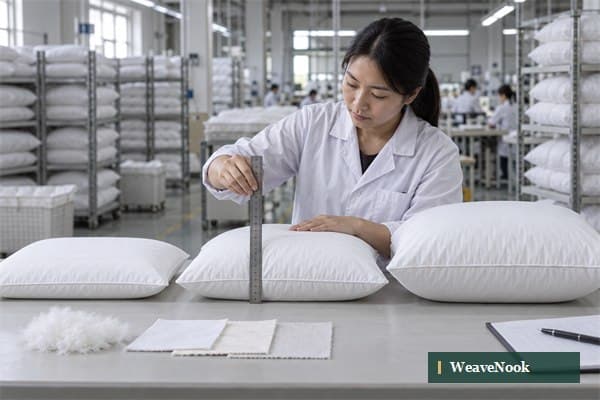
Direct answer: Treat yarn movement at a woven seam separately from broken thread or torn fabric. Select a suitable laboratory method, then inspect the production seam and pillow insertion behaviour.
Introduction
A pillowcase side seam can open visually even when the sewing thread is intact. In a loosely balanced woven fabric, yarns may shift away from the stitching under load and form a gap. This is seam slippage, and it is different from a snapped thread, torn cloth or a seam that was never fully sewn. Calling every opening “weak stitching” can send the factory toward the wrong correction. A buyer needs to identify which mechanism occurred before changing seam allowance, stitch density or fabric.
This article develops a pillowcase seam slippage testing plan for hotel and retail sourcing. It explains the role of woven construction, finished-seam geometry, pillow insertion and laundering. It does not prescribe a universal force limit or claim that a specific factory lot has passed a method. The buyer and technical laboratory should select the appropriate method, specimen and acceptance rule for the actual fabric and application.
Review the pillowcase product category for the intended opening and finish. The pillow seam and fill-migration guide concerns filled pillows; a removable pillowcase has a different load path and material construction. Keep these decisions separate even when the same retail set contains both products.
Recognise the failure mode correctly
Slippage, rupture and missed stitching are not synonyms
At a slippage gap, the woven warp or weft yarns are displaced near a seam. The sewing thread may remain continuous, and the adjacent cloth may not be torn. In a seam rupture, threads or fabric can break. A missed stitch or inadequate backtack is a workmanship defect. Photograph both sides of the opening and note whether the gap occurs along the same direction of yarn movement. A close inspection can save unnecessary machine adjustments.
The ISO 13936-1 overview concerns resistance of yarn systems to slippage at a sewn seam in woven fabrics using a fixed-seam-opening method. Its scope matters: the method is about woven-fabric behaviour at a seam, not a blanket test of every finished pillowcase defect. Ask the laboratory how it will prepare specimens representing the actual seam and whether other methods are more suitable to the material and contract. Do not report an invented “ISO pass” without a documented criterion.
If a hole appears far from the stitch line, consider fabric tear or snagging instead. If the stitching unravels at an opening end, inspect closure and reinforcement. The investigation should classify defects before assigning responsibility to the fabric mill or sewing line. A visual gap alone does not identify the root cause, but its location and shape narrow the questions.
Pillow insertion creates a specific load
Pillowcases are repeatedly opened, stretched and pulled over a pillow. A tight case or oversized pillow can concentrate force at side seams and opening corners. A retail customer may tug from one end, while hotel housekeeping may use a rapid insertion method. Check the intended pillow dimensions and loft, not just the pillowcase flat size. A seam could look acceptable on a table but gap during normal assembly.
At development, ask representative users to insert the actual pillow into the case several times. Record where tension concentrates and whether they twist or pull the opening. This is an application trial, not a substitute for a laboratory method. It can reveal a design mismatch such as inadequate case clearance or poorly placed seams. A sample tested without the intended pillow misses that part of the decision.
| Observation | Possible mechanism | Next check |
|---|---|---|
| Yarns move beside intact stitches | Woven seam slippage | Fabric direction and lab method |
| Sewing thread breaks | Stitch or thread failure | Thread, needle and stitch construction |
| Cloth tears away from seam | Fabric strength issue | Relevant tensile or tear assessment |
| Gap begins at opening end | Local reinforcement or handling | Insertion trial and endpoint construction |
| Gap appears only after wash | Differential shrinkage or damage | Care route and post-wash dimensions |
Examine woven fabric direction and construction
Test both relevant directions
Woven cloth has warp and weft directions. Seam orientation determines which yarn set may move under load. If a pillowcase is cut in a different direction for a printed pattern, the slippage risk can change. The lab request should identify fabric direction and the actual seam orientation. A single result from one direction should not be silently applied to all edges and sizes.
Yarn density, weave structure, finishing and surface friction can influence the resistance to yarn movement. A higher thread count is not proof of good seam behaviour, and “hotel grade” is not a test method. Compare the exact production fabric, including dye or finish if those differ from the greige sample. The fabric tensile standard overview addresses maximum force and elongation; it is useful for a different failure question and should not be substituted for seam-slippage evidence.
Do not approve only a fabric swatch
A fabric result helps choose material, but the finished case adds stitch line, seam allowance, hem and opening shape. Ask the sample room to sew production-representative seams using the intended thread, needle and machine settings. Inspect the case after ordinary pillow insertion and care. A special laboratory seam may not match a narrow production seam; note the difference in the report and decide whether a finished-product trial is needed.
Material and sewing teams should review findings together. If a fabric is prone to slippage, widening seam allowance may help in some contexts but is not a universal cure. It can alter case dimensions and appearance. A different seam type or material may be a better solution; test rather than guess. Altering several variables at once obscures which change worked.
Turn the decision into a sample brief
Share the product, target market, planned quantity and pillowcase seam slippage testing criteria. We can discuss a suitable sample and quotation route.
Get a QuoteDesign a valid sample and laboratory request
Define sample state and population
State whether specimens are from development fabric, first production or finished shipment. Include lot codes, colour, weave, finish and care history. If several colours share a base fabric but have different finishing, do not assume one colour’s result covers all others without justification. Ask the laboratory for the needed sample size and direction. Reserve additional material in case a result needs clarification.
Agree the target seam opening or force criterion with the buyer’s technical adviser before testing. A numerical limit copied from another brand’s product may be unsuitable. The laboratory can report the procedure and values; the purchase agreement decides acceptance. Treat measurements close to a boundary according to an agreed decision rule rather than rounding them to whichever side is convenient.
Make the test report useful to production
Request method edition, specimen conditioning, fabric direction, seam construction, load or opening point, individual results and observed failure mode. A report that says “seam strength 200 N” may describe rupture, not slippage; check the method. Share relevant observations with the mill and sewing floor so they can address the actual mechanism. Keep the report linked to a physical sample and specification revision.
When testing a finished article, document which seam was selected and how the specimen was extracted. Destructive sampling should be planned and costed, not improvised on a customer’s display sample. If lab coupons are used, ensure they represent the production fabric and sewing operation. The golden-sample guide offers a way to retain matching reference pieces with reports.

Evaluate laundering and fit after care
Review dimensional change alongside the seam
The fabric may shrink differently in warp and weft. After care, the case may fit more tightly and exert greater load during insertion. A seam that did not gap on a fresh sample may do so on a washed one. Use the intended hotel or retail care route, not an unrelated aggressive cycle chosen solely to create a failure. Measure the case and pillow before repeating the insertion trial.
If the case has an envelope opening, measure usable overlap after laundering as a separate characteristic. A short flap can expose the pillow even when side seams are sound. The envelope-flap depth guide gives the related fit decision; the buyer should still check its own actual pillow. Never fix a seam-slippage problem by quietly enlarging the case without approving the final bed appearance. Record the washed case and matching pillow as a pair, since an apparently improved seam can conceal a case that is now too loose or presents poorly on the bed.
Look for interactions with finishes
Softening or other finishes can change fabric hand and yarn mobility. If the mill changes the finish during bulk production, ask whether previous seam evidence still applies. An attractive hand-feel improvement that makes the fabric easier to shift at a seam may need a new trial. Conversely, excessive stiffening to resist slippage may make the case unpleasant for guests. Assess both quality and use.
Record the number of laundering cycles and recovery conditions. A home-laundry result does not automatically apply to commercial laundry. When a buyer requests a durable hotel product, specify its actual process and compare a retained control. Avoid claiming a precise service life from a small accelerated test. The purpose is to find a workable design and detect relevant degradation early.
Bring the result into factory inspection
An inspector can check case dimensions, seam allowance, stitch consistency, opening endpoints and visible yarn movement on sampled finished units. They should not apply an arbitrary hard pull and call it a standard test. A defined manual handling check can be useful if its steps and interpretation are agreed. Reserve laboratory tests for questions that require a measured force or controlled seam opening.
Trace failures by fabric lot, seam orientation, machine and operator. If gaps cluster in one colour but not another, material or finishing deserves attention. If they cluster at one opening end, sewing or handling may be more plausible. Use that pattern to sample further and control the affected stock. The lot-sampling and shipment-release guide helps define the population and decision authority.
When a correction is made, approve a revised sample and update the sewing sheet. Do not rely on a verbal instruction such as “sew a little wider.” Specify the actual seam construction and allowable dimensions. Ensure that a widened seam does not reduce the finished pillowcase below the intended fit allowance. The final check should still include an actual pillow insertion.
Record the rejected construction as well as the approved one. When a repeat order is placed months later, the fabric mill or sewing team may otherwise repeat the original configuration because it looks familiar. A short change record should say which yarn movement was observed, what adjustment was made and which follow-up sample demonstrated acceptable behaviour under the agreed procedure.
Write a clear quotation and approval brief
Supply fabric construction, colours, finished pillowcase size, opening type, intended pillow size, care route and seam appearance target. State whether a seam-slippage lab result is required, who selects the method and how samples will be drawn. Ask the supplier to identify any uncertainty about fabric availability or sewing method before pricing. An alternative weave may cost more but reduce a known gap risk; that is a legitimate priced option if the buyer can compare finished samples.
Define the sequence: fabric approval, production seam trial, pillow-fit check, care trial, lab evidence if needed and first-bulk inspection. A buyer may decide that a low-risk decorative case needs a lighter plan than a high-turnover hotel case. That judgment should be explicit. Do not demand testing as theatre, and do not waive it casually when the product application makes seam opening a real concern.
Frequently Asked Questions
Is seam slippage the same as a weak seam?
No. Slippage is yarn movement at a sewn seam in a woven fabric. Thread rupture, fabric tearing and missing stitches are different mechanisms. A general “weak seam” description may hide the corrective action. Photograph the defect, inspect the components and choose a method that measures the relevant behaviour.
Will more stitches always prevent the gap?
Not necessarily. Stitch density can influence a seam, but the weave, yarn mobility, allowance and load direction also matter. Too many needle penetrations may damage fabric. Make a controlled sewing trial with the production material and test or inspect the finished case after the intended care and pillow insertion.
Should every colour be tested?
That depends on whether colours share the same base fabric, finishing route and risk. Different processing can change fabric behaviour. Document the rationale for grouping or separating colours and choose representative production samples. A certificate for an unrelated colour or finish should not be applied without analysis.
Can a pillowcase pass in the lab but still fail in use?
Yes, if the lab specimen or loading does not represent the actual case, or if fit and laundering create conditions outside the test. Laboratory results and an assembled-pillow trial answer complementary questions. Link each to the approved material and construction, and investigate any disagreement rather than selecting the more convenient result.
Conclusion
Pillowcase seam slippage is a specific woven-fabric and construction problem, not a generic synonym for poor sewing. Identify the failure mode, test relevant fabric directions, sew production-representative seams and assess the case on the actual pillow after care. Write the method and decision rule into the brief. That gives the buyer a fair release standard and the factory a precise problem to solve.
Primary sources and method boundaries
Sources reviewed October 9, 2026. Illustrative calculations and proposed review checklists are not certified test results. Confirm the applicable method, edition and acceptance limits with your laboratory and customer.
Send your project requirements
Email info@WeaveNook.com with sizes, materials, care route, volumes and destination. Project-specific evidence and capability must be confirmed for your order.
Send Your Requirements