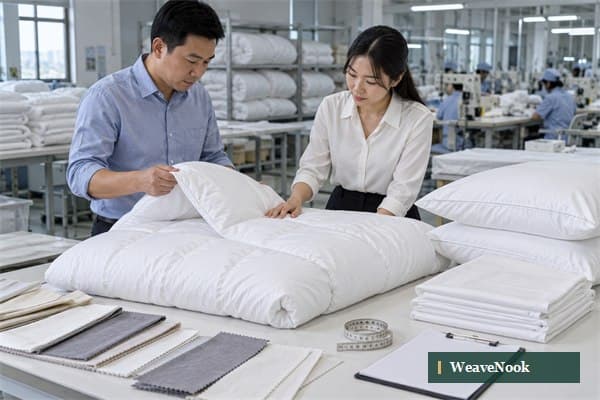
Direct answer: Measure fabric mass per area on representative, conditioned specimens using an agreed method. Keep shell GSM, filling weight and total article weight separate. Sample locations, moisture, trims and finishes can affect results. Establish a tolerance from suitable development evidence rather than treating a single cut swatch or supplier headline value as the whole order.
Introduction
A blanket labelled 300 GSM and a duvet described with a 300-gram fill do not share the same specification. One value concerns mass per fabric area; the other concerns the quantity of filling in an article or another stated reference. Even two fabric GSM values can be misleading if specimens, conditioning and sampling differ. Buyers need to identify exactly what is being weighed and how it represents the order.
This bedding GSM measurement guide explains a procurement workflow for fabric mass, sampling and interpretation. It is not a substitute for a laboratory method and does not report completed WeaveNook measurements. All arithmetic examples are hypothetical. Ask a suitable laboratory to select the current method, conditioning and specimen plan, and set customer limits from relevant evidence rather than a universal percentage.
Our thread-count versus GSM guide compares purchasing concepts. Here the narrower question is whether a quoted mass-per-area value is measured consistently and can be connected to the supplied sheets, shells or blanket fabric. A reliable answer needs a material identity, an area basis and a representative sample.
Define the quantity being specified
Fabric GSM is mass per unit area
GSM expresses grams per square metre. It does not independently state fibre, weave, softness or warmth. Ask whether the supplier’s value applies to the finished fabric, unfinished cloth or a composite construction. A fabric receiving a finish may not have the same reported mass as an earlier production stage. Keep the defined stage visible in the quotation and approval record.
The ASTM D3776/D3776M overview concerns fabric mass per unit area. The technical team should confirm the appropriate procedure and specimen scope for the material. Do not use a brief public overview as a complete laboratory instruction or assume that a quick workshop cut-and-weigh exercise reproduces the standard in full.
Separate shell, filling and finished article mass
Duvet shell GSM verification concerns the shell material. Fill mass describes the filling quantity under the stated article or area basis. Total article mass includes shell, filling, thread, attachments and other components. Write separate fields for them. A heavier completed duvet is not evidence of a heavier shell, and a high shell GSM does not establish more filling or a particular warmth performance.
For blankets, confirm whether the value includes all fabric layers and surface treatments or excludes trims. A bound edge adds mass but is not necessarily part of the sampled fabric area. The supplier and buyer should agree what the measured specimen represents. Otherwise, a calculation from total finished weight may look plausible while failing to isolate the material property being purchased.
| Quantity | Unit or basis to state | Do not confuse it with |
|---|---|---|
| Shell fabric mass | g/m² at defined stage | Duvet filling mass |
| Filling allocation | g per article or explicitly stated area | Fabric GSM |
| Total article mass | g or kg per finished item | Pure shell or fill mass |
| Shipping weight | Packed gross or net weight | A textile laboratory result |
Plan representative fabric mass per area sampling
Identify material and locations
Record material code, lot, colour, finish and sampling location. Ask the technical team how many specimens and which locations are appropriate. A single cut from the most uniform-looking area may not represent a roll or blanket. Avoid sampling only edges or only the centre without a reason. Keep specimen selection linked to the question: development comparison, lot consistency or a particular complaint.
GSM sample location bias is a practical risk when the surface or construction varies. Patterned fabrics, brushed areas, decorative features and composite materials may need a plan beyond an arbitrary square. Confirm what is included in the specimen and how nonuniform construction is handled. The laboratory should explain the reporting scope instead of allowing one small number to imply uniformity across the full article.
Keep dimensions and cutting controlled
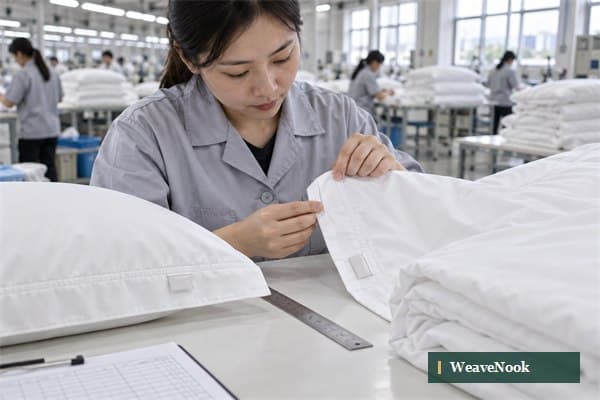
Mass-per-area calculations depend on both accurate mass and accurate area. A specimen cut smaller than assumed can produce an inflated result. Frayed edges, stretched fabric and irregular shapes also complicate the denominator. Use suitable equipment and the chosen method rather than estimating a square by eye. An informal check should be labelled as such and should not replace required independent evidence.
Record instrument suitability, measuring approach and specimen identity in the development plan. The buyer does not need to design a laboratory from scratch, but it should know whether results are comparable. A supplier’s workshop observation and a conditioned laboratory report may both be useful for different purposes. Keep them distinct rather than averaging them into one apparently authoritative value.
Control conditioned textile weight
Textile mass can respond to moisture and specimen condition. The ISO 139 overview provides conditioning context for textiles. Ask the lab which atmosphere and conditioning apply to the selected method. Do not claim a warehouse specimen has been conditioned merely because it has sat on a table for an unspecified period. Document the actual process and any agreed alternative.
Keep specimens protected between sampling and assessment so their identity and condition remain clear. If a specimen is wet, contaminated or altered by handling, tell the laboratory rather than silently drying or cleaning it. The preparation may affect interpretation. The laboratory should guide any necessary procedure, and the report should disclose the assessed state.
Compare like with like
A fabric weighed directly after an operation may not match its conditioned result. That does not automatically prove the supplier changed the material. Review timing, preparation and method first. If a production-control measurement differs from the laboratory result, ask the technical team how the internal check should be interpreted and whether it needs a defined correlation or separate acceptance rule.
For buyer comparisons, use results at the same defined material stage and conditions where practical. If matching evidence is unavailable, mark the difference rather than ranking materials solely by their reported GSM. A higher number may reflect a different finish or moisture state, not a meaningful quality advantage. Material selection still needs feel, care and application evidence.
Turn this decision into a sample brief
Send the product type, target market, planned quantity and your bedding gsm measurement requirements. We can discuss the information needed for a relevant sample and quotation.
Ask for Product CatalogUnderstand the arithmetic and its limitations
Hypothetical specimen calculation
Suppose an illustrative specimen has an accurately established area of 0.01 square metres and a conditioned mass of 2.8 grams. Dividing 2.8 by 0.01 gives 280 grams per square metre. This demonstrates the relationship only. It does not specify the specimen size required by a particular method or establish that any WeaveNook fabric measures 280 GSM.
If that specimen’s true area were smaller than assumed, the reported value would change. This illustrates why the denominator matters as much as the balance. A decimal display on a scale does not guarantee an accurate result when specimen area or condition is poorly controlled. Keep calculation precision aligned with the actual measurement capability and reporting procedure.
Hypothetical total-weight estimate
A plain hypothetical blanket measuring 1.5 by 2 metres has a nominal area of 3 square metres. At 280 GSM, the fabric-only arithmetic estimate is 840 grams. Binding, seams, labels and other components can change total finished mass, while actual dimensions and material variation also matter. Do not reject an article solely because its gross weight differs from that simplified estimate.
The calculation is useful as a plausibility check and packing input, not a replacement for direct measurement. If the discrepancy is important, define which quantity is wrong or uncertain before investigating. Compare actual dimensions, trim mass and relevant fabric specimens. Keep the customer’s fabric requirement separate from any shipping-weight target so one does not silently replace the other.
Set blanket weight consistency criteria responsibly
Agree whether the buyer controls fabric GSM, total article mass or both. Establish tolerances from the material, measurement method and customer requirement. This guide does not prescribe a universal allowed variation. A tolerance should be practical to assess and meaningful to the application, not simply copied from another fabric category because the number looks professional.
Review consistency across specimens and articles rather than approving only an average. An average can conceal a broad spread or a local variation important to the design. Ask the technical team to propose the relevant reporting approach. Keep individual observations when useful and distinguish a lot-level acceptance rule from a development target.
Do not treat weight as a warmth guarantee
A heavier blanket or duvet may feel different, but warmth depends on more than mass per area. Material, structure, air spaces and the finished configuration matter to the appropriate performance assessment. If warmth is a selling point, define the required evidence separately. Do not convert a GSM difference into a percentage insulation improvement without a suitable measured basis.
Likewise, a heavier sheet is not inherently more comfortable or more durable. It may change drying, drape and feel in ways the customer values differently. Include the actual product application and care review in selection. A quantitative fabric property is useful because it is specific, not because it can answer every purchasing question by itself.
Connect the measurement to production control
Ask how incoming material is identified and compared with the approved specification. Factory testing can use a defined internal control method, while independent reports may serve a different verification role. Confirm the relationship between those records. The buyer should not assume that every workshop observation is a certified result or that the absence of a report means no internal checking occurred.
Review material and finishing substitutions. A supplier may retain the target GSM while changing another property important to the customer. The approved specification should therefore include the relevant fibre, construction, finish and application requirements alongside mass. Matching one number is not complete equivalence. Use a revised sample and evidence plan where changes affect the approved configuration.
Plan shipment inspection realistically
Final inspectors can review documents, article identity, dimensions and weight checks within the agreed scope. They may not have the equipment or conditions to perform the full laboratory procedure. State which findings are screening observations and which are release criteria. If production samples need conditioned testing, reserve time and define sample selection before arranging transport.
Use the bedding shipment inspection guide to attach the measurement requirement to a clear lot and specification revision. A report should identify what was sampled and measured. Do not request an undefined GSM check at the last minute and then compare it with a laboratory value obtained under different conditions.
Investigate a weight discrepancy without jumping to conclusions
Collect the report, sample identity, method, conditioning, area calculation and material stage. If the customer weighed the complete article, separate that result from fabric GSM. Confirm whether packaging was included. Review dimensions and trim construction. Those basic distinctions can resolve an apparent conflict without alleging a material substitution prematurely.
If matched evidence still differs materially, investigate the lot, finish and sampling pattern with the supplier and laboratory. Retain representative specimens and ask for a targeted follow-up plan. Do not repeatedly cut small samples until one yields a favourable number. Selection and reporting should remain transparent, including results that do not support the preferred conclusion.
Keep a one-page measurement record
Create a record with product and material codes, component scope, lot, sampling positions, method, conditioning and results. Attach the laboratory report rather than copying only its headline number. Include the approved tolerance and the person responsible for interpretation. This makes the value useful to a buyer who joins the project later and has not seen the original sample discussion.
Use the same record structure for replenishment evidence, while retaining each report’s actual scope. If the internal check changes, document the change instead of preserving a misleading appearance of continuity. A short traceable record is more useful than many screenshots of balance displays whose specimen area, conditions and identity cannot be established.
Frequently Asked Questions
Is duvet fill weight the same as shell GSM?
No. Fill weight concerns the filling quantity under its stated basis, while shell GSM concerns fabric mass per area. Total article weight includes additional components. Put each quantity in a separate specification field and identify units. Confusing them makes both quotation comparison and later inspection less reliable.
Can buyers estimate blanket GSM from total weight?
Only as a clearly limited plausibility calculation when area and component scope are understood. Trims, layers and actual dimensions may affect the result. A total-weight estimate does not replace representative conditioned fabric measurement under an agreed method. Determine which quantity the customer actually needs to control before choosing the check.
Why might two reports for similar fabric differ?
They may concern different lots, finishes, specimen locations, preparation or conditioning, as well as genuine material differences. Compare the complete report details before drawing conclusions. If the comparison matters to selection, request matched evidence. Similar colour or a shared commercial fabric name does not establish an identical specimen.
Does higher GSM guarantee better bedding?
No. It describes a particular mass-per-area property. Feel, structure, care, dimensions and relevant performance remain separate. Choose the value that supports the intended application and verify the actual article. Avoid turning a heavier material into an unsupported promise of greater warmth, longer life or superior comfort.
Conclusion
Make GSM useful by defining the material, stage, area, conditions and sampling plan. Separate shell, filling, article and shipping weights, and use calculations as transparent planning tools. Connect the measured property to the full product specification and production evidence. That gives buyers a meaningful comparison without treating one fabric number as a complete measure of quality.
Primary sources and method boundaries
Sources reviewed September 28, 2026. Illustrative calculations and proposed review checklists are not certified test results. Confirm the applicable method, edition and acceptance limits with your laboratory and customer.
Send your project requirements
Contact info@WeaveNook.com with the specification, care route, quantities and delivery destination. WeaveNook is based in Shenzhen with an 8,000 m² factory; project-specific capabilities and test evidence must be confirmed for your order.
Send Your Requirements