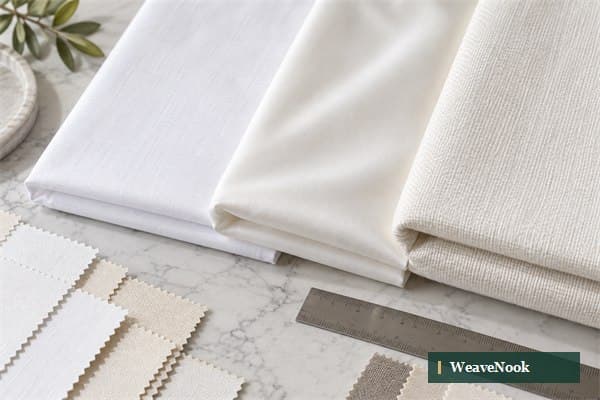
Direct answer: Use thread count and GSM as supporting data, not as shorthand for quality. A hotel sheet should be compared by fibre composition, yarn and weave description, finished weight where relevant, hand feel, dimensions, seam construction, finish and expected laundering conditions.
1. Define the buyer decision
Thread count and GSM are useful reference points, but neither can describe a hotel sheet on its own. Fibre, yarn, weave, finish, width and care routine all influence how a sheet feels and performs in service.
Hospitality sheets are selected for a combination of guest hand feel and operational repeatability. A fabric that feels attractive on a swatch may react differently after washing, ironing, storage and repeated bed making. Sample review should follow the intended product application.
2. Build a checkable specification
The following points turn this buying question into details that can be stated in an RFQ and reviewed on a finished sample.
Fibre composition
Confirm the exact fibre mix and any requested claim. Fibre choice affects moisture handling, feel, care and how the fabric presents after laundering.
Weave and yarn
Describe the weave and yarn approach rather than relying on an isolated headline number. These construction details help suppliers quote like-for-like.
Finished dimensions
Flat-sheet, fitted-sheet and pillowcase sizes must reflect the target bed and regional convention, including depth and shrinkage allowance where agreed.
Finish and care
Discuss the desired appearance after the planned wash and finishing routine. A finish should be selected against the actual service environment, not a generic expectation.
Ready to compare a real specification?
Send your hotel sheets thread count vs gsm requirements for a focused quotation and sample discussion.
Get a Quote3. Set the sample and inspection route
For sheet programs, sample review should include fabric hand feel, colour or white standard, cut size, hem dimensions, elastic where applicable, label position and the agreed packing fold. If wash testing is requested, agree the method, cycles and acceptance criteria before testing starts.

4. Compare the available approaches
| Specification input | What it indicates | What it does not prove alone |
|---|---|---|
| Thread count | A yarn-counting convention | Hand feel, strength or construction quality |
| GSM | Fabric mass per square metre | Fibre quality, weave or durability |
| Approved wash-tested sample | The chosen fabric in product context | A guarantee beyond the stated test or approval scope |
5. Avoid these sourcing mistakes
- Buying by thread count alone
- Comparing fabric swatches without checking the finished sheet construction
- Omitting fitted-sheet pocket depth from the brief
- Using a consumer care claim without checking commercial-laundry relevance
Frequently asked questions
Is a higher thread count always better for hotel sheets?
No. It is one construction reference among several; compare fibre, yarn, weave, finish, sample hand feel and service requirements.
Should hotel buyers specify GSM?
GSM can be useful when it is relevant to the product, but it should sit beside fibre composition, weave, size and finish rather than replace them.
How should fitted sheets be specified?
State mattress width, length, depth, elastic arrangement, fabric, hem or seam construction, label position and any allowance agreed for the market.
What is the best way to compare quotations?
Use one shared specification and request each supplier to state any assumption or deviation in writing.
Turn this decision into an approved brief.
Share the product application, quantity and the specification points above. WeaveNook can then discuss samples and a quotation based on the same finished-product requirements.
Send Your Requirements