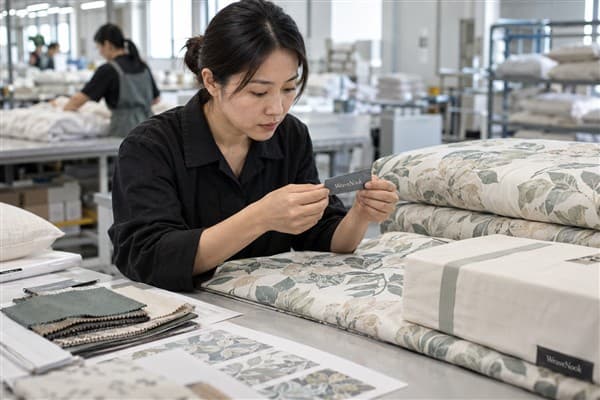
Direct answer: For customised home textiles, buyers should define what is custom and what can remain standard: size, fabric, colour, print, fill, construction, trims, labels and packaging. Convert the design intent into an approved product brief, artwork revision, sample route and inspection plan before bulk production begins.
1. Define the buyer decision
Customization adds value when it is connected to the buyer’s commercial goal, whether that is a hotel identity, a retail collection, a gift programme or a fit for a particular market. It adds avoidable delay when choices are added without a single approved reference.
Start with the customer-facing priorities and preserve simplicity where possible. A custom label or set composition may distinguish a range without requiring a new fabric, while a new print, closure, fill or packaging format can change the development route materially.
2. Build a checkable specification
The following points turn this buying question into details that can be stated in an RFQ and reviewed on a finished sample.
Custom scope
List each custom element and identify whether it needs material development, pattern change, artwork, trim sourcing, labels or special packing.
Artwork and branding
Provide approved logo files, size and placement, label content, language, barcode needs and packaging artwork with a clear version history.
Sample sequence
Agree whether the project needs fabric approval, lab dip, strike-off, prototype, pre-production sample or packing sample before the final release.
Commercial impact
Ask for MOQ, lead-time and cost implications by custom element so the buyer can make trade-offs before materials are committed.
Ready to compare a real specification?
Send your home textiles customization sourcing requirements for a focused quotation and sample discussion.
Get a Quote3. Set the sample and inspection route
Customization should be checked where it is installed: a woven label on the product, a print on the actual fabric, a logo on the specified location and packing around the finished item. Customer requirements are easier to control when the factory, buyer and brand team refer to the same artwork and approved sample.

4. Compare the available approaches
| Customization level | Typical control | Planning need |
|---|---|---|
| Standard product with private label | Label and packing artwork | Confirm placement and pack approval |
| Colour or size variation | Lab dip or pattern approval | Control range matrix and material availability |
| New construction or print | Prototype and production trial | Allow time for technical and visual approval |
5. Avoid these sourcing mistakes
- Treating a logo file as a complete product instruction
- Approving an artwork proof without viewing it on the finished material
- Not separating product, label and carton revisions
- Adding customised packing after carton dimensions are fixed
Frequently asked questions
What information does a factory need for custom labels?
Provide the artwork, dimensions, material, position, attachment method, languages, quantity and the approved product or pack reference.
Does customization always require a new MOQ?
Not always, but custom materials, colours, trims or packaging can introduce MOQ and lead-time requirements that should be quoted early.
When is a pre-production sample useful?
It is useful when bulk execution needs confirmation after materials and artwork are final but before the main shipment is made.
How should a buyer protect brand consistency?
Use controlled files, physical approvals, dated revisions and a single final product specification for every party in the project.
Turn this decision into an approved brief.
Share the product application, quantity and the specification points above. WeaveNook can then discuss samples and a quotation based on the same finished-product requirements.
Send Your Requirements