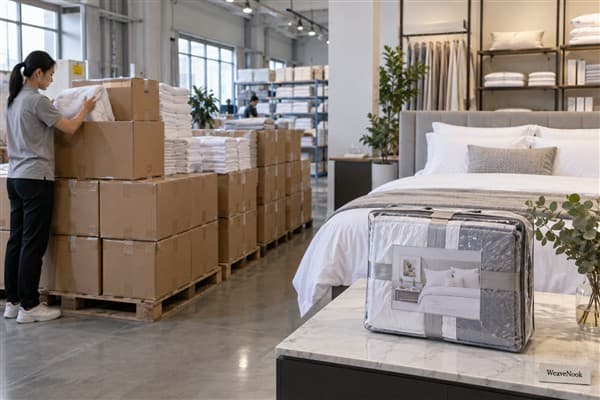
Direct answer: Buyers should check the operating context before using one home-textile specification for hotel and retail. Hotels prioritise room fit, laundry, stock control and repeat replenishment; retail prioritises customer presentation, shelf or e-commerce information, packaging and consumer-care clarity. A shared product may still need different labels, packing or size options.
1. Define the buyer decision
A bedding item that performs well in a guestroom does not automatically work as a retail SKU, and a retail-ready presentation may be inefficient for hotel receiving. The product itself can be similar, but the surrounding system is different.
Specify the commercial route along with the physical product. That gives the factory a clear basis for labels, retail inserts, inner packing, carton quantity, barcode space, room matrices and shipment preparation.
2. Build a checkable specification
The following points turn this buying question into details that can be stated in an RFQ and reviewed on a finished sample.
Operating routine
For hotels, record laundry, room turnover, storage and replenishment needs. For retail, record display, fulfilment, customer handling and returns context.
Product presentation
Define bed presentation and compatible components for hospitality; define folding, insert cards, pack visibility and unboxing experience for retail.
Identity and labels
Plan product labels, size identification, care communication, barcodes or carton marks for the people who must receive and use the item.
Commercial quantities
Map room or property quantities separately from retail SKU forecasts so MOQ, packing and lead-time discussions are realistic.
Ready to compare a real specification?
Send your home textiles hotel and retail sourcing requirements for a focused quotation and sample discussion.
Get a Quote3. Set the sample and inspection route
Before shipment, hotel goods are commonly checked against room, size and carton matrices, while retail goods also need the agreed packaging artwork and product identity. Factory testing and inspection should be product- and channel-specific rather than copied from an unrelated order.

4. Compare the available approaches
| Programme | Primary product question | Primary delivery question |
|---|---|---|
| Hotel | Will it fit the room and care routine? | Can receiving and replenishment identify every item? |
| Retail | Will the customer understand and value the product? | Does packaging protect and present the SKU? |
| Shared range | Which physical specification can be common? | Which labels and packs must differ? |
5. Avoid these sourcing mistakes
- Using retail packaging assumptions for hotel bulk deliveries
- Assuming a hotel size name matches every retail market
- Omitting barcodes or carton marks until the final week
- Specifying hotel laundry needs as a vague durability claim
Frequently asked questions
Can the same bedding set be sold to hotels and retailers?
It can, if its material, size and care fit both uses; labels, packs, quantities and product information may still need separate specifications.
What should a hotel size matrix include?
Include room types, mattress and duvet sizes, pillows, replacement quantities, product codes and receiving labels.
What should retail packaging state?
Use only approved, supportable product facts plus size, composition, care, barcode and brand information required for the intended market.
How do channel choices affect MOQ?
Different colours, sizes, packs and artwork can create separate material or packing requirements, so share the SKU split early.
Turn this decision into an approved brief.
Share the product application, quantity and the specification points above. WeaveNook can then discuss samples and a quotation based on the same finished-product requirements.
Send Your Requirements