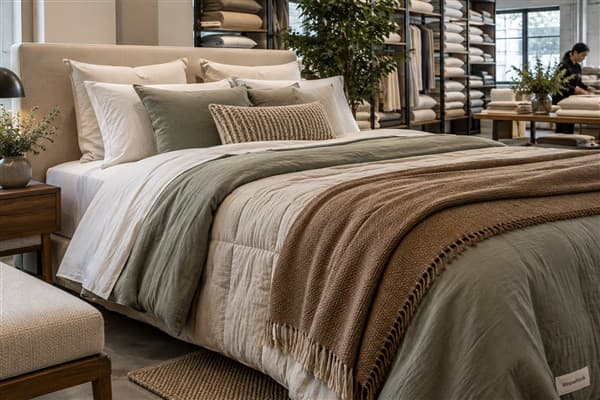
Direct answer: Check the destination climate, room conditions, user profile, layer system, fabric construction, fill and care routine before assigning seasonal or warmth language. For filled products, compare the finished size, fill type, declared fill weight and construction together; for sheets and blankets, focus on fabric construction, weight and hand feel.
1. Define the buyer decision
Seasonal merchandising can be useful, but warmth is a property of a complete product in a real setting. A lightweight blanket, a duvet cover and a filled comforter are not interchangeable ways to solve the same comfort requirement.
Define the product’s role in the bed or home before selecting a material. A breathable sheet may support a warm-climate range, while a heavier blanket adds a separate layer; the buyer should not ask one item to deliver every seasonal outcome.
2. Build a checkable specification
The following points turn this buying question into details that can be stated in an RFQ and reviewed on a finished sample.
Climate and application
Record destination climate, indoor temperature assumptions, guest or consumer expectations and whether the item is a primary cover, layer or decorative accent.
Construction and fill
For filled bedding, state fill type, declared fill weight, dimensions and construction. For unfilled items, specify fabric construction, relevant weight and desired hand feel.
Range layering
Map which sheets, covers, blankets and comforters are intended to work together so the assortment has clear options rather than duplicated warmth claims.
Care and storage
Confirm that the planned wash, dry, compression and storage routine suits the product’s thickness, construction and replenishment plan.
Ready to compare a real specification?
Send your home textiles season and warmth sourcing requirements for a focused quotation and sample discussion.
Get a Quote3. Set the sample and inspection route
A factory can verify measurable points such as finished dimensions, declared fill weight, fabric specification, stitch construction and packing recovery. It should not make unsupported thermal promises. Sample review should use the buyer’s stated application and compare like-for-like configurations.

4. Compare the available approaches
| Product role | Useful control | Buyer question |
|---|---|---|
| Sheet layer | Weave, weight and hand feel | How breathable and easy-care should the base layer be? |
| Blanket layer | Material, construction and finished weight | Is it for warmth, decor or both? |
| Filled layer | Fill, fill weight, size and baffle or quilt construction | What complete configuration is being compared? |
5. Avoid these sourcing mistakes
- Using seasonal words without defining the destination climate
- Comparing filled items by fill type but not fill weight and size
- Assuming a thicker fabric automatically suits commercial laundering
- Putting the same warmth claim on different product configurations
Frequently asked questions
Can a fabric alone determine warmth?
No. Fabric matters, but the complete product, layering, indoor setting and user preference determine practical comfort.
What should be compared for a duvet?
Compare finished dimensions, shell, fill type, declared fill weight, construction, care and sample recovery after packing.
How should retailers plan a seasonal range?
Give each product a clear role, then check that materials, colours, packaging and stock timing support that role.
Can a supplier recommend a seasonal option?
Yes, when the buyer shares climate, channel, price position and care requirements; the buyer should approve the final claim and product configuration.
Turn this decision into an approved brief.
Share the product application, quantity and the specification points above. WeaveNook can then discuss samples and a quotation based on the same finished-product requirements.
Send Your Requirements